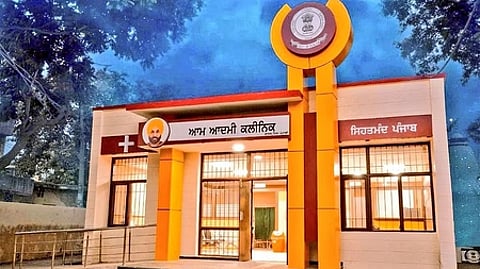

CHANDIGARH: The Aam Aadmi Clinic scheme is one of the AAP-led Punjab government's flagship healthcare initiatives, aimed at providing accessible medical services at the grassroots level to the public.
Doctors, pharmacists, and clinical assistants working at these clinics began an indefinite strike on Monday, suspending services across the State and staging protests to press for various demands, including the regularisation of services.
As a result, services at these clinics across the State have come to a complete halt, causing severe inconvenience to patients, especially to those from remote areas.
Under the banner of the Aam Aadmi Clinic Joint Front, Punjab, protests were held at several places in the State. The AAP government has set up over 1,000 'Aam Aadmi Clinics', which provide free medical treatment and tests.
Paramjit Singh, President of the Punjab Aam Aadmi Clinic Pharmacists Officers Association, said that the employees had earlier submitted a memorandum to the Director of Health Services regarding their demands.
At that time, the department had given a written assurance that the demands would be fulfilled by July 6. However, the employees allege that when union representatives approached the Health Department on July 22, officials refused to accept their demands.
Followingly, the employees decided to launch an indefinite work strike.
In Hoshiarpur, Medical Officer Dr Gurshan and Clinical Assistant Gurpreet Kaur led the protesters outside the Civil Surgeon's office.
The protesters alleged that despite holding several rounds of meetings with the State government, the health department, and repeatedly submitting memoranda, the government had taken no concrete decision to resolve their demands.
However, the employees worried about their job security and thus staged peaceful protests outside Civil Surgeons' offices across the State, making it clear that their agitation will continue until the government regularises their services.
The protesters said they submitted a memorandum to the Civil Surgeons of all 23 districts, the Director of Health Services and Health Minister Balbir Singh on several occasions, but no notification had been issued to address their concerns.
The Joint Front demanded the abolition of the empanelment system and that all medical officers, pharmacists and clinical assistants working in ‘Aam Aadmi Clinics’ be brought under the Directorate of Health Services (DHS), Punjab, through regular appointments.
The employees alleged they worked under an empanelment system, effectively being treated as daily wagers whose salaries were paid only for actual working days, excluding Sundays or national holidays.
The protesters alleged that they were not entitled to casual or medical leave and claimed that any leave taken was treated as leave without pay and employees were required to resume duty after three days; otherwise, their services were terminated.
Alternatively, it sought patient-based incentives: Rs 80 per patient for medical officers, Rs 30 for pharmacists and Rs 25 for clinical assistants, along with appointment letters under the DHS.
Among its other demands, the Joint Front sought the designation of clinical assistants as ANMs (Auxiliary Nurse Midwives) in accordance with their qualifications, the granting of experience weightage and age relaxation in future government recruitment, and the provision of 15 days of casual leave and medical leave annually.
The Joint Front said that the agitation would continue until the government issued a notification accepting its demands, stating that the State government would be responsible for any public inconvenience caused by the suspension of OPD services.
Protesting employees shared their concerns, saying they have been serving at these clinics for a long time and they examine patients, provide treatment, distribute medicines, and faithfully follow every directive issued by the government.
Despite carrying out responsibilities with dedication, their jobs have still not been made permanent. It has left them under constant mental stress and uncertainty about their future.
They said the government has yet to fulfil the promises it made and that they have been demanding regularisation of their services for a long time. The strike has had a direct and severe impact on the public.
Patients began arriving at the clinics this morning seeking medical consultation and medicines. However, finding the clinics locked and the staff absent, many were forced to return home without receiving treatment.
Elderly people and women, in particular, have been facing significant hardship due to the disruption.
On average, over 70,000 patients visit Aam Aadmi Clinics every day for treatment, free medicines, and diagnostic tests. Due to the strike, these essential healthcare services are likely to be disrupted.
As a result, patients may have to seek treatment at district hospitals and sub-divisional hospitals instead. The strike includes Medical Officers, Pharmacy Officers, and Clinical Assistants working at the Aam Aadmi Clinics.
