
NEW DELHI: India’s victory in the Kargil War cost 527 soldiers. It also triggered the most sweeping overhaul of India’s military and national security architecture since Independence.
Pakistani troops occupied commanding heights along the Line of Control (LoC) before the scale of the intrusion was fully understood. The conflict exposed an Army short of modern artillery, an Air Force lacking precision strike capability, intelligence agencies working in silos and a military command structure that struggled to present unified advice to the political leadership.
Over the past 27 years India has modernised its artillery, expanded its surveillance network, strengthened its intelligence architecture and created the post of Chief of Defence Staff (CDS). Yet the most difficult reforms have proved institutional rather than technological.
Between May and July 1999, Indian forces fought Pakistani troops and irregulars occupying heights overlooking Srinagar-Leh road. Operation Vijay lasted 85 days, with infantry assaulting fortified positions above 16,000 feet. IAF joined the campaign on May 26 under Operation Safed Sagar and Navy deployed into Arabian Sea under Operation Talwar. India declared the intruders evicted on July 26 after recapturing Tololing, Tiger Hill and Khalubar.
Three days later, the Vajpayee government appointed a four-member committee headed by strategic affairs expert K Subrahmanyam. The committee’s mandate was to determine how the intrusion had gone undetected.
The Kargil Review Committee concluded that India was operating a national security framework that had changed little since Independence. It warned that the political, bureaucratic, military and intelligence establishments had developed a “vested interest in the status quo”, preventing reforms.
A Group of Ministers headed by then Home Minister L K Advani carried the recommendations forward through 4 task forces on intelligence, internal security, and border and defence management. Its 2001 report, ‘Reforming the National Security System’, became the blueprint for later reforms.
The arsenal Kargil built
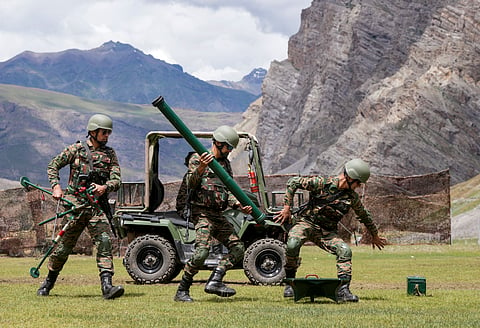
Kargil reinforced one operational lesson, decisive role of artillery in high-altitude warfare. The 155 mm FH-77B Bofors howitzers became the decisive weapon. They shattered fortified Pakistani positions.
The Army institutionalised that lesson. The Field Artillery Rationalisation Plan, approved in 1999, envisioned replacing the artillery inventory with around 3,000 guns of 155 mm calibre by 2027. Fresh inductions resumed only from 2017 with M777 ultra-light howitzer which proved their mettle during hostilities with Pakistan last year, K9 Vajra self-propelled gun and indigenous Dhanush.
Air power underwent major change. During Kargil war, IAF lacked precision-guided munitions for high-altitude warfare until Mirage 2000 aircraft were modified to deliver laser-guided bombs. By the time of Operation Sindoor last year, IAF was using BrahMos cruise missiles, SCALP stand-off weapons and loitering munitions.
For surveillance, India relied heavily on foreign satellite imagery during Kargil conflict. Today, surveillance rests on indigenous space, aerial and electronic capabilities. The Defence Intelligence Agency, formed in 2002, integrated military intelligence, while the National Technical Research Organisation followed in 2004 to strengthen technical intelligence.
Two decade wait for jointness
Reforming higher defence management proved far slower. The Headquarters Integrated Defence Staff (HQ IDS) was established in 2001. The Andaman and Nicobar Command became India’s first operational geographic tri-service command. Of 75 recommendations on defence management, 63 were implemented and 4 remained under implementation. Remaining eight relating to the creation of a Chief of Defence Staff (CDS) languished for two decades.
The proposal was accepted in 2019. General Bipin Rawat assumed office as first CDS on January 1, 2020. His mandate was to deliver integrated theatre commands before his death in December 2021.
The proposed theatre command structure would replace 17 single-service commands with integrated commanders. Officials told this newspaper that new CDS General N S Raja Subramani is expected to submit the proposal to Defence Minister Rajnath Singh before it proceeds to the CCS.The current model envisages a Northern Theatre oriented towards China under an Army officer, a Western Theatre focused on Pakistan under an Air Force officer and a Maritime Theatre under a naval officer.
Consensus remains elusive. Air Chief Marshal A P Singh has argued that IAF’s combat fleet is too limited to be permanently allocated to geographical commands. He advocated a joint planning centre in Delhi. India lacks a publicly articulated National Security Strategy. Former Army Chief Gen M M Naravane argued that creating theatre commands before publishing such a strategy risked reversing sequence of reform.
Capability and command
The 2026-27 defence budget reached a record `7.85 lakh crore. Yet structural challenges remain. After retirement of MiG-21, IAF operates 29 fighter squadrons against authorised strength of 42.5. The benchmark is under review post Operation Sindoor, with proposals to increase force levels by 30-35% as India prepares for possibility of simultaneous contingencies involving China and Pakistan. The Kargil committee report argued that India’s obstacle was not a shortage of resources but institutional resistance to change. Twenty-seven years later, that conclusion still resonates.
