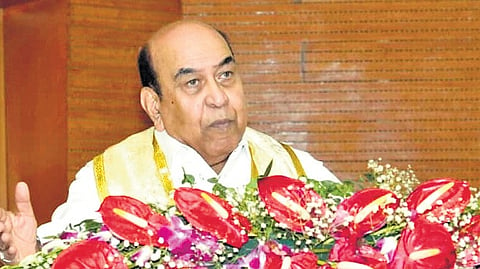

Bihar Governor Lt Gen (retd) Syed Ata Hasnain, believes India’s security preparedness has improved significantly, but cautions that national security is “a continuous process of adaptation” requiring constant “political, social and military vigilance”.
As chancellor of Bihar’s universities, he outlines an ambitious reform agenda, arguing that “systems, not personalities, must drive universities”. In an interview with TNIE, the Bihar governor discusses national security, higher education, leadership and nation building. Excerpts:
You represented India at a high-level event in Iran. How do such diplomatic engagements strengthen India’s strategic partnerships, and what role can universities play in fostering international cooperation?
Diplomatic engagement is about much more than government-to-government interaction. It builds trust, creates channels of dialogue and reinforces India’s image as a responsible and reliable partner in an increasingly uncertain world. Such engagements help sustain relationships that are important for our strategic interests, economic growth, energy security and regional stability.
Universities have an equally important role to play. They shape minds, build international networks and promote understanding across cultures through academic exchanges. India has a civilisational advantage in this regard. Institutions like ancient Nalanda attracted scholars from across Asia and became centres of global learning. We should aspire to recreate that spirit. Strong universities enhance India’s soft power.
You have served as a military commander, strategic scholar, public intellectual and now a governor. Which of these roles has taught you the most about leadership?
Frankly speaking, each role has enriched the others. The Army taught me to lead under pressure and make decisions in conditions of uncertainty, while scholarship taught me to question assumptions and think strategically. Public life reinforced the importance of listening—an attribute that proved equally valuable while commanding troops in complex hybrid situations, where understanding people was often as important as understanding the adversary. As governor, I have appreciated that lasting change is achieved by building strong institutions rather than relying on individuals.
However, certain principles remain constant. Integrity, credibility and leading by example are universal attributes of leadership. As we know, people may not always agree with a leader’s decisions, but they must never doubt the leader’s honesty. Leadership, ultimately, is about inspiring trust and enabling others to succeed.
In recent years, India has undertaken major counter-terrorism operations, including Operation Sindoor. How prepared is India today to strengthen national security?
India is significantly better prepared than ever before. Our intelligence, technology, inter-agency coordination and political resolve have all improved exponentially. However, terrorism continues to evolve. We must remain vigilant by strengthening intelligence, cyber capabilities, border management, strategic communication and international cooperation. National security is not a destination; it is a continuous process of adaptation. Political, social and military vigilance is essential at all times in areas that were, till recently, seriously affected.
Terrorism can erupt in other locations, hence the need for sensitising people at the grassroots and ensuring effective training of security forces.
As chancellor of Bihar’s universities, what are your top priorities?
My priority is to restore credibility to our universities. That means ensuring academic calendars are sacrosanct, appointments are transparent, governance is accountable and students receive quality education on time. Simultaneously, we must improve research, embrace technology, strengthen industry linkages and build institutions that can compete nationally. The objective is simple—to make these universities institutions of first choice.
How can Bihar bridge the gap between academic learning and employability?
It is a fact that degrees alone no longer guarantee employment. Universities must produce graduates who are adaptable, digitally literate and capable of continuous learning. AI, data analytics, entrepreneurship and problem-solving should become integral parts of higher education. Close partnerships with industry and practical exposure will ensure that education prepares students for the economy of tomorrow.
What structural reforms are needed to ensure timely examinations, transparent appointments and a stronger research culture?
Yes, systems, not personalities, must drive universities. Digital governance, fixed academic calendars, merit-based appointments, clear accountability and regular performance reviews are essential. Research must be encouraged through collaboration, funding and incentives. We are moving towards creating institutions where efficiency and academic excellence reinforce each other.
Students leave Bihar in pursuit of higher education. What measures can be taken to retain them?
Students migrate because they seek quality, reputation and opportunity. Our responsibility is to create those opportunities here. It is certain that better faculty, modern infrastructure, vibrant campuses, strong research and employability will gradually reverse this trend.
Having commanded troops in Siachen, Jammu & Kashmir, Sri Lanka and the Northeast, what leadership lessons from your military career can help reform university governance?
The military teaches that leadership begins with integrity, accountability and leading by example. Institutions succeed when objectives are clear, responsibilities are defined and everyone feels ownership of the mission. Basically, universities are different from military formations, but good governance, transparency and teamwork are universal.
Can universities adopt the values of discipline, teamwork and purposeful leadership that are hallmarks of the armed forces?
Certainly. Discipline should never be confused with rigidity. A well-governed university actually creates greater space for intellectual freedom, because systems function smoothly. The military encourages initiative within a framework of responsibility; universities can do the same while remaining centres of free thought and debate.
Do you believe that leadership and national security studies can better prepare the youth for the future?
Absolutely. National security today extends beyond the military to cyber security, climate change, disaster management, technology, economics and information warfare. Students need a broader understanding of these issues so they can become informed citizens and responsible leaders in an increasingly complex world.
