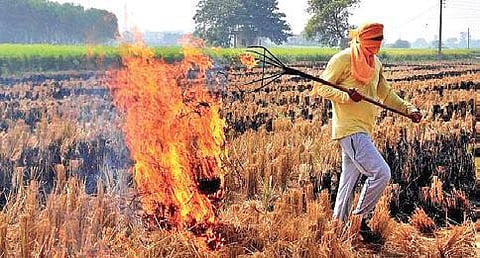

CHANDIGARH: With the winter harvest season approaching, the Punjab and Haryana governments have been asked by the Commission for Air Quality Management (CAQM) to begin procuring drones to detect stubble burning on a real-time basis.
At present, authorities can only map farm fires and enforce the ban based on satellite data.
Sources said that in May this year, the CAQM carried out a pilot project in Patiala district of Punjab, in which the visuals obtained were clear and accurate, allowing officials to pinpoint farm fire incidents.
"During the pilot project, the use of drones provided clear visuals from a considerable height, enabling authorities to take real-time action against those burning crop residue. In meetings with officials of the Punjab and Haryana governments since May, they have been asked to begin preparations for procuring drones," said an officer privy to the development.
With a pinpointed focus on controlling farm fire hotspots in both states, a detailed standard operating procedure (SOP) for the use of drones is still being formulated and is likely to be issued soon.
The number of drones required per village or district is yet to be decided, along with how many drones will be needed by both states, who will deploy them, and their technical specifications, sources said. They added that the current plan is to use these drones only in farm fire hotspots and gradually expand their deployment if required.
Officials said that satellite data is usually a day old, and the CAQM receives information on areas where farm fires occurred only after a delay. By the time the information reaches the authorities, the crop residue burning in those areas is already over.
Moreover, satellites make only around two captures a day during their overpass. However, if drones are used to detect farm fires, they will allow real-time action by ground teams to reach the spot and stop farmers immediately.
Farmers were reportedly setting fields ablaze much later in the day, after 3 pm, across both states, by which time the satellites had completed their passes. As a result, satellites failed to capture the actual number of farm fires, leading to a significantly lower count of crop residue burning.
The total burnt area was also found to have reduced by 25 to 35 per cent. This has been established and confirmed by several studies. A study conducted by the International Forum for Environment, Sustainability and Technology (iFOREST) in December last year found that Sentinel-2 satellite burnt-area mapping showed that burnt cropland in Punjab fell from 31,447 sq km in 2022 to roughly 20,000 sq km in 2025, marking a 37 per cent reduction.
In Haryana, the burnt area declined from 11,633 sq km in 2019 to 8,812 sq km in 2025, a reduction of 25 per cent.
The Indian Agricultural Research Institute (IARI), which monitored farm fire incidents between April 1 and May 31 during the Rabi harvest season, recorded 9,806 crop residue burning incidents in Punjab and 3,398 in Haryana.
During the same period last year, there were 10,207 incidents in Punjab and 1,832 in Haryana. These fires during the summer season are not considered a major public health concern because stronger winds disperse the smoke.
Last year, between September 15 and November 30, 5,114 crop residue burning incidents were recorded in Punjab and 662 in Haryana. During the same period in 2024, the figures stood at 10,909 in Punjab and 1,406 in Haryana, as farm fires are typically higher during the winter harvest season.
Last year, the Commission for Air Quality Management said that 2025 witnessed the most significant decline in farm fires. The number fell from 78,850 in 2021 to 39,186 in 2023 and further to 6,080 in 2025.
Punjab recorded a 53 per cent reduction in farm fires compared with 2024, an 86 per cent reduction over 2023, a 90 per cent reduction over 2022, and a 93 per cent reduction over 2021. Haryana also posted a 53 per cent reduction compared with its 2024 figures.
As part of the outreach programme in both states, another focus during the upcoming winter season will be to educate farmers and dispel misconceptions about the four-inch crop residue, which many believe contains pesticide remnants and therefore burn.
Officials said farmers are now increasingly using machines to remove stubble, helping reduce the practice of crop residue burning.
