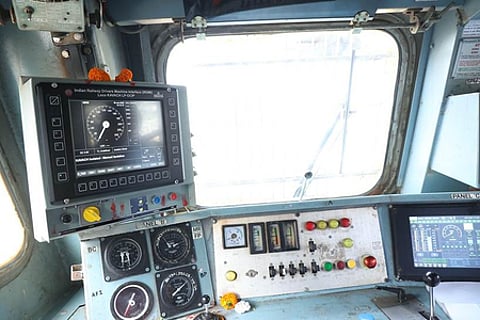

Indian Railways has commissioned its indigenous automatic train protection system Kavach 4.0 on 2,569 route km, while work is underway on another 21,858 route km. The figures suggest that only about 12% of the routes where trackside implementation has started are operational with the latest version. Railway Minister Ashwini Vaishnaw gave the figures in a reply to Lok Sabha, replying to the questions put up by MP Dr. D Ravi Kumar. Version 4.0 of this system, approved by the Research Designs and Standards Organisation on July 16, 2024, is expected to further improve location accuracy, according to the reply.
Of the 2,569 route km commissioned with Version 4.0 up to July 20, 2026, 1,423 km lie on the Delhi–Mumbai corridor and 1,146 km on the Delhi–Howrah corridor. On the Delhi–Mumbai route, 1,327 km between Tilak Bridge, Palwal, Mathura, Kota, Nagda, Ratlam, Vadodara and Virar have been commissioned, along with 96 km between Vadodara and Ahmedabad. On the Delhi–Howrah side, the commissioned sections include 563 km between Chipyana and Subedarganj, 71 km between Kanpur and Lucknow, 50 km between DDU and Bhabua Road, 43 km between Sasaram and Phesar, 159 km between Gaya, Sarmatarn and Nimiaghat, and 260 km between Chota Ambana, Bardhaman and Howrah.
Trackside implementation has been taken up across 21,858 route km, covering the Golden Quadrilateral, Golden Diagonal, High Density Network and other identified sections. Southern Railway is included, with work in progress on the Gudur–Chennai Central–Arakkonam–Renigunta, Arakkonam–Jolarpettai and Shoranur–Ernakulam sections. To support Kavach, Railways has laid 11,253 km of optical fibre cable, installed 1,668 telecom towers, set up data centres at 988 stations and provided trackside equipment across 7,726 route km. Kavach has been installed in 6,153 locomotives, with installation underway in another 7,327 locomotives and 1,200 EMU/MEMU trains.

Training has been scaled up alongside hardware deployment. More than 94,000 technicians, operators and engineers have been trained in Kavach technology, including about 57,000 loco pilots and assistant loco pilots, through programmes developed with the Indian Railways Institute of Signal Engineering and Telecommunications. The Railways has spent ₹3,874 crore on Kavach works up to June 2026 and allocated another ₹2,066 crore for 2026-27, with the ministry saying funds are being released in line with project progress. For a system where trackside infrastructure costs about ₹50 lakh per km and locomotive equipment about ₹80 lakh per loco (Business Standard, https://www.business-standard.com/), the latest allocation points to a faster rollout phase.
Kavach is part of a wider safety upgrade. Safety-related expenditure has risen from ₹39,200 crore in 2013-14 to ₹1,20,389 crore in 2026-27 (Times of India, https://timesofindia.indiatimes.com/). Electronic or electrical interlocking has been provided at 6,671 stations, with complete track circuiting at the same number of stations and interlocking completed at 10,395 level-crossing gates. Use of 60-kg high-quality rails has increased from 57,450 km during 2004-05 to 2013-14 to 1.63 lakh km during 2014-15 to 2025-26, while deployment of 260-metre rail panels rose from 9,917 km to 87,219 km. Fog safety devices grew from 90 in March 2014 to 31,693 in March 2026, and electronic interlocking expanded from 837 to 3,691 stations over the same period.
The ministry reported that weld failures fell from 3,699 in 2013-14 to 272 in 2025-26 and rail fractures from 2,548 to 208, cutting both by more than 90%. Consequential train accidents fell from 135 in 2014-15 to 16 in 2025-26, with the accident index dropping from 0.11 to 0.01 and two consequential accidents reported up to June 2026. Other measures include ultrasonic testing, track geometry monitoring, regular patrols, preventive maintenance of rolling stock, replacement of conventional ICF coaches with LHB coaches, and elimination of all unmanned broad-gauge level crossings by January 2019. The number of LHB coaches manufactured rose from 2,337 during 2004-05 to 2013-14 to 49,366 during 2014-15 to 2025-26 (Indian Express, https://indianexpress.com/).
For passengers on Delhi–Mumbai and Delhi–Howrah trains, the figures show a growing shield of technology behind the fall in accidents, even as most of the planned Kavach network still lies ahead.