
CHANDIGARH: With the 2027 Punjab Assembly elections less than six months away, the Aam Aadmi Party (AAP)-led Punjab government and the Sikh clergy appear to be on a collision course, setting the stage for a possible showdown.
Terming the government's response to objections over the proposed amendments to the "controversial clauses" in the Jaagat Jot Sri Guru Granth Sahib Satkar (Amendment) Act, 2026 as "unsatisfactory", the Akal Takht, the highest temporal seat of the Sikhs, has rejected it and on Wednesday announced the formation of a five-member committee to engage with the government on the issue.
Following objections raised by the Akal Takht, the state government's Home Affairs Department on Tuesday submitted a 26-page official response addressing 12 objections and observations raised by the Takht on the Act. The response was handed over to the Akal Takht Secretariat through AAP MLA and Chief Khalsa Diwan president Inderbir Singh Nijjar, Amritsar Deputy Commissioner Dalwinderjit Singh and SDM Gurmandar Singh.
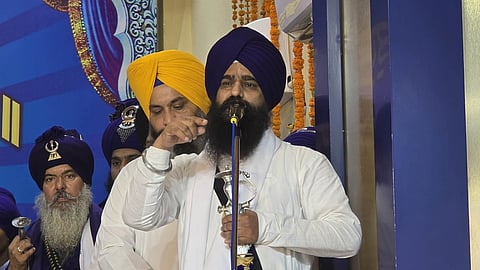
However, officiating Jathedar Giani Kuldeep Singh Gargaj said on Wednesday that the government had failed to honour the commitment made by Sikh MLAs before the Akal Takht on June 29, as the response did not reflect the consensus reached when Sikh MLAs and Cabinet ministers appeared before the Takht and assured that the proposed amendments would be incorporated.
"The response of the government is not satisfactory and cannot be accepted. It has also failed to establish timely coordination with the Akal Takht before submitting its reply," he said.
Gargaj added, "The reply by the government to the objections and suggestions submitted by the Akal Takht makes it clear that it is not prepared to amend the law in line with the sentiments conveyed by us. The government has accepted only about 10 per cent of the objections and recommendations submitted by the Akal Takht."
Despite rejecting the response, Gargaj said the Akal Takht remains open to further dialogue if the government wishes to continue discussions on the legislation. He announced the formation of a five-member committee to engage with the government on the issue.
"The committee comprises retired Justice Rupinder Singh Sodhi, retired Justice Mohinder Mohan Singh Bedi, senior advocate Puran Singh Hundal, Sikh scholar Dr Kehar Singh Patiala and Prof Jagmohan Singh of Ludhiana. SGPC Secretary Lakhvir Singh will serve as the coordinator," he said.
A key point of contention in the government's response was its refusal to remove the term "custodian" from the law. However, the government justified its inclusion through a detailed note citing provisions of the Act.
Responding to a question on Leader of the Opposition and Congress leader Partap Singh Bajwa's request for guidance to Sikh legislators attending the forthcoming monsoon session of the Assembly, Gargaj said Sikh MLAs should limit their interaction to the Speaker and participate only in the proceedings of the House. He said they should neither face Chief Minister Bhagwant Mann, nor look at him, nor respond to anything he says. Bajwa had earlier sought the Akal Takht's clarification on the issue in writing.
Earlier, Gargaj had asserted that nothing short of the July 4 recommendations, when the revised set of objections by the clergy was forwarded to the government, would be acceptable.
On June 29, the five Sikh high priests summoned Sikh MLAs from all political parties to the Akal Takht, culminating in a one-month ultimatum to amend the Act. A revised list of specific objections was officially sent to the government on July 4, along with additional recommendations regarding the law.
In the fresh representation, Gargaj raised objections to certain provisions of the Act relating to the Shiromani Gurdwara Parbandhak Committee (SGPC), Sikh Rehat Maryada, terminology and custodial definitions. He also sought an amendment to include a specific provision for legal protection of sewadars and devotees in cases of self-defence during incidents of sacrilege.
The recommendations also included the setting up of fast-track courts to ensure speedy investigation and prosecution in cases related to the sacrilege of religious scriptures.
The AAP-led government has convened the monsoon session of the Punjab Assembly from August 3 to August 10, during which it intends to table amendments to the Act.
The legislation at the centre of the controversy was passed by the state Assembly on April 13. Intended to curb incidents of desecration, the law provides for stringent punishment, including life imprisonment and fines of up to Rs 20 lakh, for acts of sacrilege involving the Guru Granth Sahib. Despite its stated objective, the law triggered sharp opposition from the Sikh clergy and various Panthic bodies over what they described as several objectionable clauses that were drafted without consultation.
