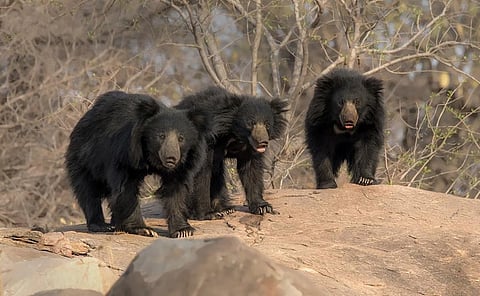

NEW DELHI: India’s sloth bear population and the area of suitable habitat for the species have both increased, according to the first comprehensive national habitat suitability assessment.
The results reveal that suitable habitat for sloth bears increased by 10.7% and the population rose by 17% between 2018 and 2022. Much of the newly suitable habitat is located within tiger reserves, reflecting the wider impact of the tiger conservation efforts.
Released by the Ministry of Environment, Forest and Climate Change on Global Tiger Day, the report, “Habitat Suitability Assessment for Sloth Bears Across Tiger Landscapes in India”, states that the positive impact of tiger conservation efforts is also benefiting the sloth bear, which plays a crucial role as an ecosystem engineer and seed disperser in tropical forest ecosystems.
According to the All India Tiger Estimation (AITE), the area occupied by sloth bear habitat within tiger landscapes increased from 170,094 sq km in 2018-19 to 188,357 sq km in 2022-23. Using predictive MaxEnt modelling, the assessment estimated about 231,899 sq km of suitable habitat across the country.
Of this, 28% lies within protected areas, while 19.6% or 45,441 sq km falls inside tiger reserves. The remaining suitable habitat is spread across reserved forests, territorial forests and other forested landscapes outside formally protected areas.
Dr Qamar Qureishi, former scientist at the Wildlife Institute of India, said the findings reflect an annual increase of about 3.33% in habitat area and a 5% annual increase in the abundance index based on sloth bear photographs, calling the trend encouraging.
The report warns that rising human pressure has become the main factor affecting habitat suitability. It says addressing habitat fragmentation and human-bear conflict outside protected areas will be crucial for long-term conservation.
