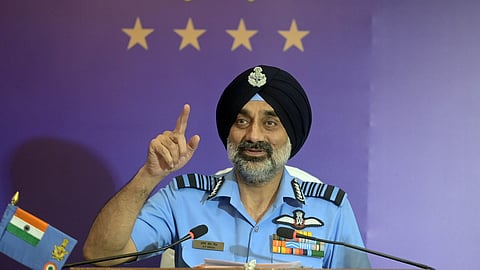

NEW DELHI: Air Chief Marshal AP Singh arrived in France on Monday for a four-day visit as India prepares to formally trigger negotiations for a mega Rafale fighter acquisition programme, one of the biggest combat aircraft deals currently in the pipeline.
The IAF chief will hold talks with senior French military officials and visit Dassault Aviation, maker of the Rafale and European missile giant MBDA, which supplies the IAF with key weapons including the Meteor beyond-visual-range air-to-air missile (BVRAAM), the MICA air-to-air missile and the SCALP deep-strike cruise missile. He is expected to return on June 5.
The visit comes as New Delhi has finalised the Letter of Request (LoR) and dispatched it to France which will now formally trigger negotiations for the proposed government-to-government acquisition.
The LoR conveys India’s operational, industrial and weapons integration requirements and seeks a formal response from Paris. Once France responds, the programme will move to the Contract Negotiation Committee (CNC) stage, where commercial, contractual and production terms will be negotiated before approval by the Cabinet Committee on Security (CCS).
Sources in the defence establishment said New Delhi has made it clear to the French side that indigenous weapons integration is a firm requirement and will be a key condition in the forthcoming negotiations.
‘The integration of indigenous weapons is a non-negotiable requirement for us. The modalities will be worked out during negotiations but there is broad understanding on the issue. The Air Chief’s visit will also provide an opportunity to take those discussions forward,’ the source said.
Sources made it clear that India is not seeking access to the source code of the Rafale’s systems as no OEM shares that for a frontline fighter. Instead, New Delhi will push during the CNC stage for the requisite Interface Control Documents, technical arrangements that would facilitate integration and certification of weapons such as the Astra BVRAAM, the future BrahMos-NG and other indigenous systems over the aircraft’s service life.
As reported earlier by TNIE, the proposed deal envisages 88 single-seat and 26 twin-seat Rafales. Out of these, 18 aircraft are expected to be delivered in fly-away condition, with the remainder to be built in India with indigenous content progressively rising to around 40-50 per cent.
Dassault already has an established aerospace production ecosystem with Tata Advanced Systems Limited (TASL), which manufactures Rafale aero-structures and components. The two companies have also announced plans to produce Rafale fuselage sections in India, providing a potential foundation for the local production effort under the mega fighter programme.
If negotiations proceed on schedule, the contract could be inked in the first half of next year, with deliveries of the initial aircraft beginning by 2030 and local production gathering pace subsequently.
The contract is also expected to cover future upgrades. The IAF’s existing fleet of Rafales currently flies in the F3 standard and is slated to be upgraded to the F4 configuration. The new aircraft are also expected to include provisions for eventual migration to the future F5 standard once it becomes available.
ACM Singh’s visit also follows the IAF’s move last month to localise sustainment of its MICA air-to-air missiles through an agreement with MBDA to establish a Maintenance, Repair and Mid-Life Overhaul (MRO) facility in India.
Under the arrangement, the IAF will operate the facility while MBDA will provide machinery, technical data packages, training and engineering support.
The acquisition is aimed at arresting the IAF’s declining squadron strength and is expected to complement the Tejas Mk-1A, the upcoming Tejas Mk-2 and the Advanced Medium Combat Aircraft (AMCA) in the years ahead.
