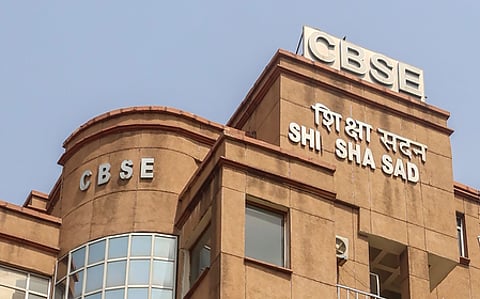

The Centre on Tuesday reshuffled the top leadership of the Central Board of Secondary Education (CBSE) amid allegations of irregularities in the Class 12 On-Screen Marking (OSM) digital evaluation system, transferring CBSE Chairman Rahul Singh and Secretary Himanshu Gupta and appointing senior bureaucrats Lokhande Prashant Sitaram and Varun Bhardwaj in their place.
Lokhande Prashant Sitaram, a 2001-batch IAS officer of the AGMUT cadre currently serving as Additional Secretary in the Ministry of Home Affairs, has been appointed as the new CBSE chairperson. Varun Bhardwaj, a 2008-batch Indian Information Service (IIS) officer currently working as Director in the Ministry of Education, has been named the new CBSE secretary.
The Appointments Committee of the Cabinet (ACC), chaired by Prime Minister Narendra Modi, approved the changes. Singh has been moved as Additional Secretary in the Ministry of Agriculture and Farmers Welfare, while Himanshu Gupta has been prematurely repatriated to his parent cadre in the Ministry of Home Affairs on administrative grounds with an “extended cooling-off” condition, making him eligible for another central deputation only after December 12, 2030.
The reshuffle came hours after the government ordered a high-level probe into the procurement of services for the OSM system and constituted a one-member committee to examine the matter. The committee will be headed by S. Radha Chauhan and will investigate how the CBSE selected vendors for the online marking platform. It has been empowered to seek assistance from other departments and is required to submit its report to the Department of Personnel and Training within one month. The memorandum was also shared with the Department of School Education and Literacy.
In parallel, the controversy over the OSM system was also discussed before a parliamentary panel, where a 17-year-old student from Jharkhand, Sarthak Sidhant, presented a seven-page note highlighting alleged anomalies in the CBSE’s tendering process for selecting vendors for online marking. Sidhant, who appeared for the Class 12 examinations himself, placed his findings before the Parliamentary Committee on Education, Women, Children, Youth and Sports, chaired by Congress MP Digvijaya Singh.
The student also raised a series of questions regarding procurement transparency and the functioning of the digital evaluation system.
CBSE, meanwhile, told the panel that “malicious actors” attempted to disrupt its re-evaluation portal through cyberattacks, including a denial-of-service attack that generated 1.5 million hits within two minutes and more than one lakh attempts of unauthorised file access. The board said its system currently supports over 8,000 concurrent users and that more than 16,000 students had successfully completed submissions as of 3 pm.
The board further informed the committee that glitches on the portal had been resolved and that students were given time till June 6 to apply for re-evaluation of their answer sheets.
The parliamentary panel had called senior officials of the CBSE and the Ministry of Education to review concerns surrounding the adoption of the OSM system and difficulties faced by students. It also discussed the implementation of the three-language formula in Classes 9 and 10 during the same meeting.
Committee chairman Digvijaya Singh said the panel would evaluate the responses received, adding that final conclusions would be drawn by the committee. He declined to comment further on the language policy issue, noting that the matter was sub-judice.
“The committee has always been looking at the issues of students and their problems. This is exactly what the committee has done,” Singh told reporters.
Separately, CBSE also reiterated that its re-evaluation portal had faced coordinated cyber disruption attempts, including large-scale denial-of-service attacks and repeated unauthorised access attempts, but said the system had been stabilised. Based on feedback, it has extended session time limits and refined the platform to improve user experience.
Concerns over the OSM system have continued to be raised by students and parents, particularly regarding alleged answer-sheet mismatches, technical glitches, payment failures, and delays in verification and re-evaluation processes, prompting wider demands for transparency and accountability in the digital evaluation system.
(With inputs from PTI)
