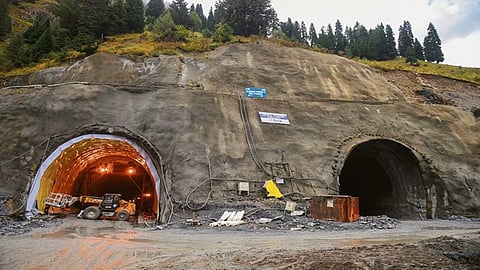

SRINAGAR: The strategically important 13.15-kilometre-long Zojila tunnel at the border of Jammu and Kashmir and Ladakh will achieve a crucial stage on June 9 when Union Minister of Roads, Transport and Highways Nitin Gadkari triggers a breakthrough blast.
Once completed, the tunnel will become the world’s longest single‑tube bi‑directional road tunnel at an altitude of 11,500 feet. It will provide all-weather connectivity between the Kashmir valley and Kargil in Ladakh.
Harpal Singh, joint chief operating officer of Megha Engineering and Infrastructures Limited, which is constructing the tunnel, told this newspaper that the excavation work on Baltal–Zojila main tunnel has reached the final stage.
“Of the total tunnel length of 13.15 kilometres, excavation work on 13.14 kilometres has been completed. Now just 10 meters of excavation work is remaining,” he said.
The project was awarded to the company in October 2020 and work started in April 2021. The tunnelling work was started simultaneously from both ends—Baltal in Kashmir and Minamarg on the Ladakh side—using a two-way working front strategy to speed up construction. Singh said that since excavation work has dropped below 10 meters, the tunnelling work is now being done on the Minamarg side only.

According to officials, Gadkari will visit the Zojila construction site to trigger the final breakthrough blast. Engineers and workers have battled tough construction conditions in the Himalayas for this tunnel, including fragile geology, unstable rock formations, water ingress, etc. At present, around 1,200 engineers, technicians, mechanics and labourers are engaged in the project.
Being built at an estimated cost of `2,600 crore, the Zojila tunnel is 7.57-metre-high horseshoe-shaped single-tube, two-lane tunnel, which will pass under the Zojila Pass in Himalayas. The tunnel is being constructed using the New Austrian Tunnelling Method, a system particularly suited to fragile Himalayan geology. All international safety norms have been strictly integrated into the project, ensuring zero compromise on safety despite complex geology, water ingress issues and tunnel collapse risks, Singh said.
Company officials have said that once excavation work is finished, work on concrete lining and installation of a sophisticated ventilation system will be taken up. Once operational, the tunnel will have two-lane traffic and a dedicated 1.5-metre-wide walkway for maintenance and emergency crews.