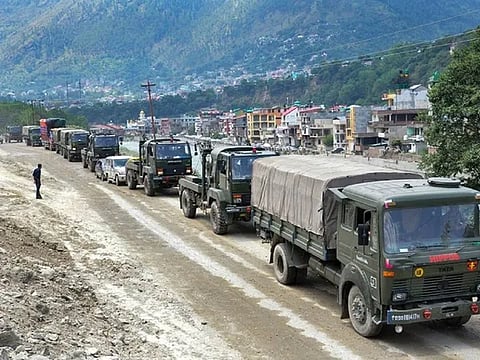

NEW DELHI: The Indian Army is pushing a slew of road, rail, aviation and logistics infrastructure projects along the country’s northern and western borders to boost strategic mobility and cut deployment timelines, as military planners seek to strengthen the rapid movement of troops, armour and supplies during contingencies.
The effort is being driven through the Centre’s PM GatiShakti National Master Plan, under which the Army is working closely with multiple infrastructure ministries to make sure that military requirements are built into major connectivity projects being developed across border regions.
The push comes against the backdrop of a prolonged military deployment along the Line of Actual Control (LAC) since 2020 and continuing operational requirements along the western front, both of which have underscored the importance of robust connectivity and logistics networks in sustaining large-scale military presence over extended periods.
While many of the projects are being executed by civilian ministries, the Army has embedded itself into the planning and monitoring process for those with strategic relevance. A dedicated GatiShakti cell has been set up at Army Headquarters led by Lt Gen Sanjay Mitra, with nodal officers at Command Headquarters coordinating with infrastructure agencies.
“The focus is on making sure that national infrastructure investment also meets military requirements. We are not building parallel systems but integrating into what is already being planned and funded,” an Army official said.
A key focus is road connectivity in border states. Highway projects involving four-laning and six-laning of stretches in Punjab, Jammu and Kashmir, Uttarakhand, Sikkim and Arunachal Pradesh are being pursued to improve what military planners call “surge capacity” or the ability to rapidly move forces and logistics to the front during a crisis.
On the railways, the Army is working with the railways ministry on additional lines, track doubling, bridges and terminal facilities along key sectors. These are expected to reduce distances to forward areas and accelerate movement of troops and heavy equipment, an area where constraints have historically slowed mobilisation. “Getting additional railway lines along the western borders alone can make a significant difference to how quickly we can respond,” the official added.
Civil aviation infrastructure forms another component of the effort. Airport upgrades, heliports, strengthened runways and greenfield airports with dual-use potential are being developed in several areas, with particular importance in remote and difficult terrain where airlift capability is often the only viable option.
Furthemore, the Army is also looking at the network of Multi-Modal Logistics Parks being developed under the national logistics push. With integrated warehousing, fuel storage and transport connectivity, these facilities could provide additional logistical support during contingencies, supplementing the military’s existing infrastructure and strengthening operational sustainment capabilities.
