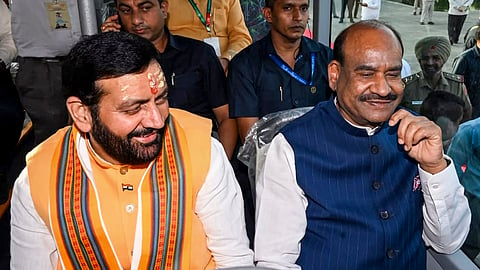

CHANDIGARH: Lok Sabha Speaker Om Birla on Monday stated that policies and laws formulated in our legislatures must resonate with the aspirations and requirements of the new generation.
Addressing the inaugural session of the conference of the Commonwealth Parliamentary Association (CPA), India Region, Zone-II, being hosted by the Haryana Vidhan Sabha, Birla called for a massive mass movement (Janandolan) across the country, so that every citizen feels a sense of personal contribution toward building a developed India.
Expressing confidence, he said that when the participation of every individual is ensured, India’s collective strength—especially its youth power—will become so formidable that we will accomplish the goal of 'Viksit Bharat' well before the target year of 2047. In this context, he mentioned that while India's growing population was once viewed as a challenge, today that very youth demographic has become its greatest strength. To leverage this, the youth must be equipped with skill development, quality education, and a mindset for innovation.
Underlining the importance of public participation in a parliamentary democracy, Birla remarked that regular public discourse and meaningful debates should instill confidence among citizens that the House belongs to them and that their elected representatives are their true voice.
Consequently, the discussions, policies, and laws framed within the houses must always be driven by national interest and accompanied by enhanced public engagement.
He asserted that greater public participation leads to deeper and more widespread social transformation. The more citizens connect with democratic institutions, the faster the dream of a developed India will be realized. He emphasized that whether it is a Gram Panchayat, Panchayat Samiti, Zila Parishad, Municipality, State Legislative Assembly, or the Lok Sabha—increased public participation brings forth new ideas, diverse perspectives, and constructive suggestions, giving fresh momentum to the pace of development.
Describing the 21st century as highly crucial, Birla observed that the global landscape is undergoing major shifts and the world is navigating various geopolitical tensions. Even during such challenging times, India is consistently moving forward on the strength of its long-term policies and plans, backed by good governance and a stable, strong, and robust legal framework.
He added that while closely studying global trends in developed nations, India has introduced necessary and pragmatic changes from time to time, tailored to its own social and economic conditions. Today, the entire world looks toward India with renewed hope and immense possibilities; therefore, this is the time for collective efforts and comprehensive participation.
Birla further noted that the more transparent and robust a state’s legal framework is, the faster that state progresses. He expressed hope that during the proceedings of this conference, there would be substantive and result-oriented discussions on vital topics such as the 'Resolve of Viksit Bharat', 'Public Participation', 'Mass Movements', and 'Collective Responsibility'.
The Presiding Officers from the legislatures of 12 states are taking part in this conference including Haryana, Punjab, Himachal Pradesh, Jammu & Kashmir, Delhi, Madhya Pradesh, Maharashtra, Goa, Uttar Pradesh, Sikkim, and West Bengal.
Detailed deliberations are being held across various plenary sessions on the theme, 'Role of an Aware Society and Representatives of the People in Facing Future Challenges and Realizing the Goal of Viksit Bharat–2047'.
While Haryana Chief Minister, Nayab Singh Saini said that emerging challenges such as Artificial Intelligence (AI), cybersecurity, climate change, rising energy demands, the digital economy, global competition and social inequalities require not only administrative responses but also public awareness, social participation and strong legislative leadership.
He said that the world is undergoing unprecedented transformation and that democratic institutions must continuously evolve to effectively address the challenges of the future. He said that Haryana has embraced the vision of Viksit Bharat @2047 not merely as a slogan but as a collective commitment.
He said that the state government has translated this vision into action through concrete initiatives aimed at preparing Haryana for the future.
Highlighting one such initiative, he said that the establishment of the Department of Future in 2025 marked a unique and pioneering step in the country. The department reflects the government's resolve to proactively prepare for future challenges rather than postponing them for the next generation. The policies, reforms and priorities that will define Haryana in 2047 are being shaped today, he added.
The blueprint for a ‘Viksit Vidhan Sabha’ can only be drawn by those who understand the needs, aspirations and challenges of their constituencies at the grassroots level. To strengthen this process, the state government has decided to organise a special Chintan Shivir for all members of the Haryana legislative assembly.
He said the exercise would not be a routine meeting but a platform for meaningful reflection and policy dialogue, where legislators would discuss constituency-specific challenges, potential solutions, public expectations and the roadmap for building a developed constituency and a developed state.
Saini observed that issues such as Artificial Intelligence, data security, cybercrime, water security, biodiversity conservation and the growing influence of social media are no longer subjects confined to expert discussions. They have become integral components of legislative discourse and public policymaking.
Legislators who understand these issues today, he said, will be better equipped to guide society tomorrow.
Expressing satisfaction that the conference would also feature a special presentation on ‘Artificial Intelligence and Human Rights,’ he said the topic reflects the need to balance innovation with ethical responsibility and democratic values.
