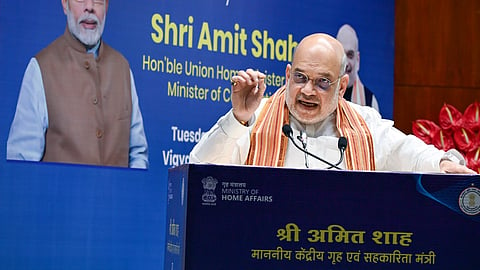

NEW DELHI: Union Home Minister Amit Shah on Tuesday launched the Land Port Management System (LPMS) ‘Vinimay’, a certified digital platform designed to modernise and streamline operations across India’s land ports, marking a significant step towards technology-driven border management.
The integrated platform will enable seamless coordination among multiple agencies involved in land port operations, including customs, immigration authorities, border guarding forces and other regulatory bodies. The system aims to improve efficiency, transparency and security while facilitating smoother movement of cargo and passengers.
Speaking at the launch function, Shah said the transformation of India’s land ports reflects Prime Minister Narendra Modi’s vision of strengthening border security while enhancing trade and connectivity.
“The idea of the Land Ports Authority was primarily driven by security concerns. Under Prime Minister Narendra Modi’s leadership, land ports have evolved into the first line of border security while also making trade smoother and more secure,” he said.
The Home Minister noted that land ports have acquired a broader role beyond security and commerce, serving as important links between people living across international borders. According to Shah, these facilities have become instruments of regional connectivity and cooperation alongside their core functions of trade facilitation and border management.
Highlighting the impact of land ports on national security and economic activity, Shah said their rapid development has contributed to increased trade volumes while helping address challenges such as illegal trade and migration.
“Land ports have not only strengthened security and boosted trade but have also helped convert illegal trade into legitimate trade channels. They have played a significant role in addressing migration-related challenges and supporting the overall development of border regions,” he said.
Describing the launch of LPMS as a landmark initiative, the Home Minister said the platform would accelerate India’s transition towards a modern, technology-enabled smart border management ecosystem, aligned with the vision of a developed India by 2047.
The LPMS is designed as a unified digital platform integrating operations across all land ports. It will facilitate secure, real-time exchange of logistics and regulatory information, bringing land port operations in line with the digital systems already deployed at airports and seaports.
The government said the platform functions as a neutral and open system that will enable seamless interaction among government agencies and private stakeholders, reducing procedural delays and improving operational efficiency.
The new system introduces end-to-end digital workflows for both cargo and passenger processing, including slot booking, online payments, tracking services and single-window clearances. It is integrated with key national digital platforms such as ICEGATE, the Unified Logistics Interface Platform (ULIP), and the motor vehicle ecosystem, enabling interoperable and transparent border management.
The Land Ports Authority of India (LPAI), a statutory body under the Ministry of Home Affairs’ Department of Border Management, is responsible for developing and managing land ports to strengthen trade, connectivity and regional cooperation.
At present, the LPAI operates 15 land ports along India’s international borders. These include Attari and Dera Baba Nanak on the India-Pakistan border; Rupaidiha, Raxaul and Jogbani on the India-Nepal border; Darranga on the India-Bhutan border; Petrapole, Dawki, Sutarkandi, Golakganj, Mankachar, Agartala, Srimantapur and Sabroom on the India-Bangladesh border; and Moreh on the India-Myanmar border.
