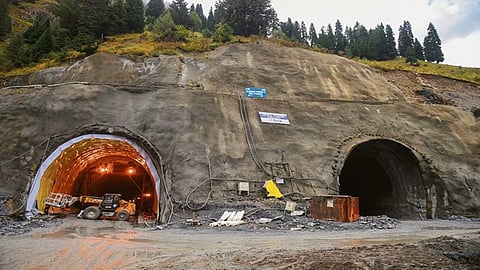

SRINAGAR: The strategically important 13.15 km-long Zojila Tunnel, the world's longest single tube bi directional road tunnel at an altitude of 11,500 ft, is set to achieve a historic breakthrough on Tuesday, with Union Minister for Road Transport and Highways Nitin Gadkari scheduled to trigger the final breakthrough blast.
The tunnel will provide all weather connectivity between Ladakh and the rest of the country and marks a major milestone in one of India's most challenging infrastructure projects.
The project was awarded to Hyderabad based Megha Engineering and Infrastructures Limited (MEIL) in October 2020, and construction began in April 2021.
Tunnelling work commenced simultaneously from both ends, Baltal in Kashmir and Minamarg on the Ladakh side, using a two way working front strategy to accelerate construction.
Gadkari will visit the Zojila Tunnel site on Tuesday and trigger the final breakthrough blast, marking the completion of a critical phase of the excavation process.
Following the breakthrough blast, a few vehicles may be allowed to pass through the tunnel in a symbolic move.
Since work began in April 2021, engineers and workers of MEIL have battled some of the toughest construction conditions in the Himalayas, including fragile geology, unstable rock formations, water ingress, avalanche prone terrain and severe winter weather.
The engineers and workers have operated in temperatures ranging from minus 20 to 30 degrees Celsius during winter months each year, officials said.
At present, around 1,200 engineers, technicians, mechanics and labourers are engaged in the project, which will provide all weather connectivity between Jammu and Kashmir and Ladakh.
Built at an estimated cost of ₹2,600 crore, the Zojila Tunnel is a 7.57 m high horseshoe shaped, single tube, two lane tunnel that will pass beneath the Zojila Pass in the Himalayas between Ganderbal in central Kashmir and Drass town in Kargil district of Ladakh.
The tunnel is being constructed using the New Austrian Tunnelling Method (NATM), a technique particularly suited to fragile Himalayan geology and variable rock conditions.
NATM relies on sequential excavation, immediate support measures such as shotcrete and rock bolting, and continuous geotechnical monitoring, allowing engineers to respond flexibly to changing ground conditions during tunnelling.
According to MEIL officials, all international safety norms have been strictly integrated into the project, ensuring zero compromise on safety despite complex geology, water ingress issues and tunnel collapse risks.
They said the execution of the project has involved exceptional engineering challenges, including fragile geology, sensitive rock formations, avalanche prone terrain and harsh winter conditions.
“To keep this route safe and operational in all seasons, special cut and cover structures and safety walls are being built here. These modern techniques will protect the entire corridor from the harsh dangers of winter, ensuring that connectivity between Ladakh and rest of the country remains secure even in the most difficult weather,” they said.
Located in the Zojila region between Baltal and Minamarg in the Union Territories of Jammu and Kashmir and Ladakh, the project will provide all weather connectivity to Ladakh with the rest of the country. Ladakh remains cut off for long periods every year due to heavy snowfall, avalanches and extreme weather conditions.
Besides the main tunnel, the project scope includes connecting highway works, bridges, protective structures, cut and cover sections, snow protection components and the Nilgrar twin tunnels.
With the completion of excavation, work on concrete lining and the installation of a sophisticated ventilation system will be taken up.
Once operational, the tunnel will accommodate two lane traffic and include a dedicated 1.5 metre wide walkway for maintenance and emergency crews.
Every 750 metres, a 40 metre long widened section has been provided to allow vehicles to be moved aside during breakdowns or emergencies.
Advanced fire safety systems, including automatic fire detection and suppression mechanisms, will be installed throughout the tunnel.
The tunnel will also have extensive snow protection infrastructure, including catch dams, air blasts, protection walls and deflator dams over a distance of six kilometres to protect it from snowstorms.
The overall project completion target remains February 2028.
Once operational, the Zojila Tunnel will significantly reduce travel time between Srinagar and Leh by approximately three and a half hours, boost tourism, improve the supply of essential goods, benefit local residents and enhance India's strategic and military mobility in the sensitive border region.
The tunnel will also strengthen defence capabilities by ensuring the hassle free movement of military personnel, hardware and supplies to the Union Territory of Ladakh, which shares borders with Pakistan and China.
