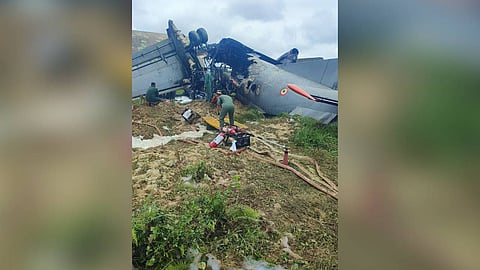

NEW DELHI: Five Indian Air Force personnel were killed and a co-pilot injured when an An-32 transport aircraft crashed while landing at Air Force Station Jorhat in Assam on Saturday morning. The aircraft, on a routine sortie, went down around 10 am at the Rowriah airbase and caught fire.
The personnel killed were Squadron Leader Prashant Singh, Flight Lieutenant Shubham Kumar, Sergeant Jitendra Sharma, Agniveervayu Khemaram Kumawat and Agniveervayu Danish Alam.
A court of inquiry has been ordered to ascertain the cause of the accident.
The crash has once again drawn attention to the An-32 fleet, which remains one of the Indian Air Force’s most important transport assets despite being more than four decades old.
India procured 125 An-32 aircraft between 1984 and 1991. The twin-engine transport aircraft is capable of carrying up to 6.7 tonnes of cargo or 50 paratroopers and is designed to operate from short runways and high-altitude airfields.
The aircraft routinely ferries troops, ammunition, engineering stores and rations to advanced landing grounds that remain inaccessible by road for significant parts of the year.
The fleet assumed added significance after the 2020 military standoff with China in eastern Ladakh, when the armed forces undertook one of the largest sustained troop deployments along the Line of Actual Control in decades.
Despite the induction of the C-130J Super Hercules and C-17 Globemaster III fleets, the An-32 continues to shoulder a substantial share of the Air Force’s day-to-day logistics requirements. Its ability to operate from short, semi-prepared runways at high altitudes keeps it indispensable in ways larger transport aircraft cannot replicate.
The accident is also likely to renew attention on the fleet’s safety record.
The An-32 has been involved in several accidents during its service with the Air Force, including the disappearance of an aircraft carrying 29 personnel over the Bay of Bengal in 2016 and the crash of another An-32 in Arunachal Pradesh in 2019 that killed all 13 personnel on board.
With airframes now exceeding 40 years of service, maintaining the fleet has become increasingly challenging. A 2017 report by the Comptroller and Auditor General highlighted serviceability rates as low as 40 per cent, citing shortages of critical spares and maintenance challenges.
The Russia-Ukraine conflict further disrupted the supply of critical spares and navigation aids, forcing the Air Force to pursue indigenous alternatives and alternative sourcing arrangements.
To extend the fleet’s operational life, India signed a 400 million dollars upgrade programme with Ukraine’s Antonov in 2009, covering life-extension measures and avionics modernisation for 40 aircraft in Ukraine, along with technology transfer for the remaining 64 aircraft to be upgraded at the IAF’s No. 1 Base Repair Depot in Kanpur.
In a parliamentary reply in early 2024, Defence Minister Rajnath Singh said a significant portion of the fleet had already been upgraded, while the remainder was being overhauled domestically. The oldest airframes are expected to begin retiring from around 2032, while upgraded aircraft could remain in service until 2037-2040.
The induction of 56 Airbus C-295 aircraft is underway to replace the IAF’s ageing Avro fleet under India’s first major private-sector military aircraft manufacturing programme. While 16 aircraft are being delivered from Spain in flyaway condition, the remaining 40 are being manufactured by Tata Advanced Systems in Vadodara, with the first indigenously assembled aircraft expected to roll out in September 2026.
The C-295 is expected to gradually absorb a portion of the missions currently undertaken by the An-32 as the fleet expands, although it is primarily intended to replace the Avro aircraft.
For the larger medium-lift requirement, the programme that most directly addresses the eventual replacement of the An-32 has moved through its initial bureaucratic stages. The DAC cleared the acquisition of 60 Medium Transport Aircraft in March this year.
The programme will follow the Buy and Make route, with 12 aircraft to be delivered in flyaway condition and 48 manufactured in India at an estimated cost of around Rs 1 lakh crore. The MTA is intended to replace the ageing An-32 and Il-76 fleets while enhancing both strategic and tactical airlift capability.
The proposal must still progress through the RFP (Request for Proposal) stage, followed by competitive evaluations, commercial negotiations and final approval by the Cabinet Committee on Security before a contract can be signed.
The formal RFP is expected to be issued later this year. The principal contenders are Lockheed Martin’s C-130J Super Hercules, Embraer’s C-390 Millennium and Airbus’ A400M Atlas.
The C-130J sits at the lower end of the payload requirement at around 19 tonnes, while the C-390 offers a payload of roughly 26 tonnes. The A400M, capable of carrying around 37 tonnes, exceeds the specified payload band but remains under consideration because of its broader capabilities.
The eventual selection will depend on operational performance, lifecycle costs, industrial participation commitments and the extent of manufacturing and technology transfer offered in India.
