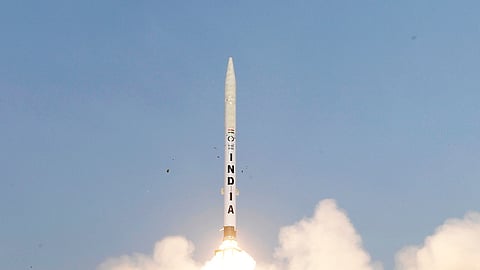

NEW DELHI: India has notched up another milestone in its long quest for a credible missile shield, with the DRDO acing three back-to-back flight-tests of its second-phase, multi-layered ballistic missile defence (BMD) system.
The trials on June 10-11witnessed interceptors destroy targets in both the endo-atmospheric (within the atmosphere) and exo-atmospheric (outer space) regimes.
Phase II is built to defend against faster, longer-range missiles than the original shield, with the system designed to eventually scale up to intercontinental class.
The DRDO said the successes had placed India in “the elite group of nations having BMD capability” to engage threats up to ICBMs.
The government statement did not specify the range of the targets engaged in the trials. Sources, however, put the latest intercepts in the IRBM-class 2,000 to 5,000 km band.
This is far from India’s first tryst with missile defence.
The two-phase BMD programme has logged interceptor trials for nearly two decades, beginning with the Phase-I Prithvi Air Defence and Advanced Air Defence systems.
Phase II opened with the maiden AD-1 interceptor test in November 2022, followed by a full network-centric system trial in July 2024 that demonstrated a capability against 5,000-km class missiles.
The systems lean on indigenous long-range tracking radars, low-latency communication links and advanced kill vehicles and are tailored to counter China’s Dongfeng family and Pakistan’s Shaheen-III missiles.
In a third, separate trial, the DRDO carried out the maiden flight-test of the Naval Anti-Ship Missile-Medium Range (NASM-MR), a subsonic, sea-skimming weapon with a strike range of around 300 km.
Geared to arm MiG-29K fighters, frontline warships and P-8I patrol aircraft, the NASM-MR will progressively replace the navy’s ageing Russian-origin Kh-35 anti-ship missiles.
From Phase I to Phase III
India’s BMD testing began in the mid-2000s as a two-layered answer to Pakistan’s expanding missile inventory and later recalibrated against China’s far deeper arsenal.
Phase I paired the Prithvi Air Defence missile for high-altitude exo-atmospheric kills with the Advanced Air Defence missile for lower endo-atmospheric intercepts.
The shield works as a single networked organism. Launch vehicles hold the interceptors, while specialised long-range radars hunt and track an incoming missile from hundreds of kilometres away.
That data feeds into Launch Control Centres and, above them, a Mission Control Centre that classifies the threat, computes its trajectory and commits the right interceptor.
The DRDO has begun work on Phase-III, anchored by two next-generation interceptors internally designated AD-AH and AD-AM.
These are being developed to defeat a tougher class of weapons. The first is the hypersonic glide vehicle, which travels above Mach 5 and changes trajectory mid-flight to dodge interception.
The second is the missile carrying Multiple Independently Targetable Re-entry Vehicles (MIRVs), where a single launch releases several nuclear warheads, each programmed to strike a separate target.
China is fielding hypersonic systems and a growing fleet of long-range missiles led by the DF-41, while Pakistan has tested the MIRV-capable Ababeel.
The Phase-III interceptors are at an early conceptual stage, with the DRDO yet to begin flight-testing.
