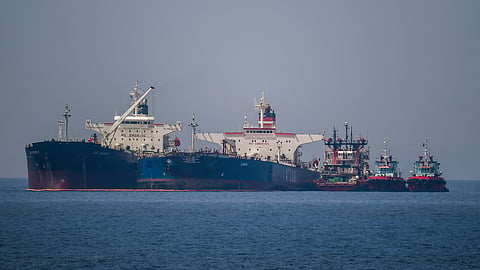

India was the world’s second-largest importer of Russian fossil fuels in May, bringing in an estimated 5.8 billion euros (USD 6.7 billion) worth of hydrocarbons as domestic refiners ramped up crude purchases from Moscow, according to a report by the Centre for Research on Energy and Clean Air (CREA).
The think tank said crude oil dominated India’s imports from Russia, making up about 83 per cent of the total at 4.8 billion euros. Imports of oil products stood at 550 million euros, while coal accounted for 429 million euros.
“India's total crude import volumes recorded an 8 per cent month-on-month increase in May. This is partially explained by a 21 per cent month-on-month increase in Russian imports,” CREA noted.
Refining centres across India reported higher Russian inflows during the month. At the Vadinar refinery in Gujarat, unloaded Russian crude volumes rose 36 per cent from April levels, while the Jamnagar refining complex saw a 14 per cent increase in deliveries.
State-run refiners also increased their intake after resuming Russian crude purchases earlier this year. The New Mangalore and Visakhapatnam facilities, which had stopped imports at the end of November 2025, restarted buying in March and continued procurement through May.
New Mangalore recorded a 13 per cent month-on-month rise in Russian crude imports, while Visakhapatnam saw a sharper 42 per cent jump, CREA said. The Paradip refinery in Odisha also posted its highest Russian crude volumes in two years, reflecting sustained demand for discounted supplies despite geopolitical and sanctions pressures.
India has emerged as one of the largest buyers of Russian oil since Western sanctions reshaped global energy trade following the Ukraine conflict. Indian refiners have steadily increased purchases of discounted crude, helping manage import costs, improve refining margins, and support fuel exports.
Even as diversification efforts continue with supplies from the Middle East, Africa and the United States, Russian crude still forms a significant portion of India’s import basket.
CREA data showed China remained the largest importer of Russian crude in May with 50 per cent of exports, followed by India at 36 per cent, Turkiye at 6 per cent, and the European Union at 5 per cent.
“In May 2026, China remained the largest global buyer of Russian fossil fuels, accounting for 38 per cent (Euro 7.0 billion) of Russia's export revenues from the top five importers. Crude oil made up 69 per cent (Euro 4.8 bn) of China's purchases, followed by pipeline gas (Euro 618 million), then coal (Euro 525 million), and lastly LNG (Euro 510 million). Oil products (Euro 479 million) constituted the remainder of China's imports,” CREA said.
The report also highlighted continued flows of Russian-linked refined products into sanctioning markets despite restrictions. Although the EU banned imports of oil products made from Russian crude from January 21, 2026, it still received 10 shipments of such products in May.
“Refineries using Russian crude in India, Turkiye, Brunei, and Georgia exported Euro 641 million of oil products to sanctioning countries in May 2026. The importers included the EU (Euro 174 million), Australia (Euro 275 million), the US (Euro 147 million) and New Zealand (Euro 45 million). An estimated Euro 214 million of these products were refined from Russian crude,” the report said.
It added that US-bound exports originated from Reliance Industries Ltd’s Jamnagar refinery, the SOCAR-owned STAR refinery in Türkiye, and the Tupras Izmit refinery. “In the prior three months, 39 per cent of the STAR refinery's crude oil feedstock and 15 per cent of the Jamnagar refinery's feedstock came from Russia,” CREA noted.
(With inputs from PTI)
