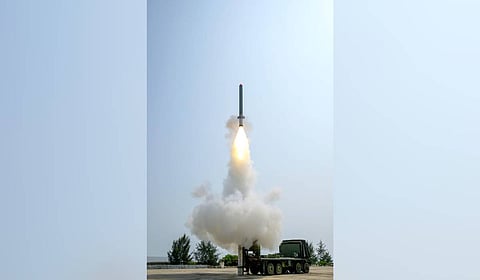

NEW DELHI: India’s effort to develop a Tomahawk-class land-attack cruise missile moved a step closer to fruition on Monday, with the Defence Research and Development Organisation (DRDO) successfully conducting the second publicly known flight-test of the Long Range Land Attack Cruise Missile (LR-LACM) off the Odisha coast.
The test was carried out from the Integrated Test Range at Chandipur using a mobile articulated launcher. In a statement, DRDO said all mission objectives were achieved, with the missile’s performance monitored through radar, electro-optical tracking systems and telemetry stations deployed along the flight path.
The latest trial follows the missile’s maiden flight-test in November 2024 and advances the development of a weapon being pursued by all three services.
About six metres long and weighing roughly a tonne, the missile uses waypoint navigation and terrain-following capabilities to strike targets at extended ranges. Its ability to fly at low altitudes, manoeuvre in flight and adopt sea-skimming profiles enhances survivability against modern air-defence and radar networks.
Powered by the indigenous Manik Small Turbofan Engine, the missile is being configured for launch from mobile ground launchers and naval vertical launch systems. Development of an air-launched variant is also underway.
LR-LACM has an estimated range of 1,000-1,500 km, placing it in the category of long-range land-attack cruise missiles fielded by major military powers.
Why India wants a Tomahawk-class missile
The requirement for such a capability has become increasingly important as modern militaries place greater emphasis on conventional long-range precision strikes. The missile is intended to engage high-value targets such as command centres, air bases, logistics hubs, radar stations and air-defence networks deep inside hostile territory without exposing launch platforms to enemy defences.
For India, the LRLACM is expected to complement rather than replace the BrahMos. While the BrahMos offers a high-speed strike capability, the LR-LACM is meant to provide a longer-range, terrain-hugging option capable of penetrating heavily defended airspace and sustaining conventional deep-strike operations.
The Navy’s interest is particularly significant. Once integrated with universal vertical launch systems being adopted across frontline warships, the missile will allow Indian naval platforms operating in the Arabian Sea or Bay of Bengal to hold strategic targets hundreds of kilometres inland at risk without entering contested waters.
With the LR-LACM, India is moving towards fielding a capability already possessed by a handful of major military powers. The United States operates the Tomahawk land-attack cruise missile, Russia fields the Kalibr family, while China deploys the CJ-10 as part of its long-range conventional strike arsenal. Pakistan, too, has inducted successive variants of the Babur cruise missile.
The missile traces its origins to the Nirbhay programme launched in 2013. Several Nirbhay developmental trials suffered setbacks involving propulsion, navigation and flight-control systems, forcing DRDO to repeatedly redesign critical subsystems. Those efforts eventually yielded the indigenous Manik turbofan engine along with a range of guidance, navigation and terrain-following technologies that now underpin the LRLACM.
Those technological gains have reduced India’s dependence on imported propulsion systems and laid the foundation for a family of indigenous long-range cruise missiles.
The IAF received the initial nod from the DAC for the missile in August 2023 and the Army in February 2024, with proposed acquisitions estimated at Rs 10,000 crore and Rs 4,000 crore, respectively. The Navy is expected to seek approval for its own requirement, estimated at around 200 missiles worth Rs 5,000 crore, after developmental trials are completed.
Additional developmental and user-assisted trials are expected before the missile enters production.
