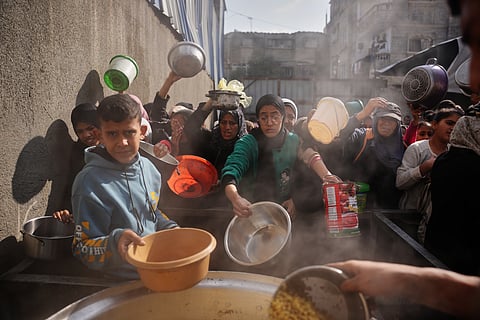

The Embassy of Palestine in India has issued an urgent appeal for immediate international intervention and medical assistance, warning that the healthcare system in the Occupied Palestinian Territory has reached a critical stage and is on the "verge of total collapse".
"The Embassy of the State of Palestine to the Republic of India expresses its profound concern over the catastrophic collapse of the healthcare sector in the Occupied Palestinian Territory as a direct result of the ongoing Israeli genocidal war, military attacks, mass destruction of medical infrastructure, severe restrictions on humanitarian access and financial strangulation measures," the embassy said in an official statement on Friday.
"It is the exact moment to save thousands of innocent lives. If not India and the Indian people; then who? If not now; then when? Every life matters," the statement added.
The embassy said Palestinians continue to look towards the international community and India, citing India's "historic commitment to justice, humanitarian values, anti-colonial principles, and support for oppressed peoples."
It also called on India to provide medical assistance under the "Aarogya Maitri" humanitarian initiative, which aims to extend India's support for global health and disaster relief.
"Recently, the Hon'ble Prime Minister of India, H.E. Narendra Modi, announced the 'Aarogya Maitri' project, where he pledged, and I quote his words: 'Under this project, India will provide essential medical supplies to any developing country affected by natural disasters or humanitarian crises.' End quote," the embassy said.
Citing data from the World Health Organization (WHO), the embassy described the situation as a "humanitarian catastrophe of unprecedented scale". It said only 19 of the 36 hospitals in Gaza remain "partially operational" under extremely limited emergency conditions.
The embassy highlighted severe shortages of essential medicines, medical equipment, dialysis supplies, blood units, and fuel needed to operate hospital generators.
"On the 986th day of the ongoing Israeli genocidal war, the healthcare system in the Gaza Strip has reached an unprecedented level of devastation. According to the World Health Organization (WHO), only 19 out of 36 hospitals remain partially operational under extremely limited emergency conditions. The World Health Organization has warned that Gaza's health system has reached a breaking point," the statement said.
The embassy also pointed to the urgent need for medical evacuation of thousands of patients, saying remaining healthcare facilities are overwhelmed due to casualties and injuries.
"International humanitarian organizations have further reported critical shortages of anaesthesia, antibiotics, dialysis supplies, blood units, surgical equipment, insulin, and fuel required to operate hospital generators. The ongoing Israeli military genocidal war has resulted in tens of thousands of deaths, casualties, and injuries, overwhelming the remaining healthcare facilities, while thousands of patients continue to remain in urgent need of medical evacuation outside the Gaza Strip," it said.
The embassy further warned that deteriorating sanitation conditions have contributed to the spread of diseases, particularly affecting vulnerable groups including children and people with weakened immune systems.
It said the presence of bodies trapped under rubble, shortage of clean water, waste accumulation and the collapse of sanitation systems have worsened living conditions in Gaza.
Citing WHO, UN, UNRWA and other humanitarian organisations, the embassy said it is estimated that 12,000 bodies remain trapped under rubble.
"These conditions have also led to the increased presence of rats, snakes, and mosquitoes and triggered the rapid spread of severe skin diseases and dangerous infestations, including lice, fleas, bedbugs, and rodent-related infections, creating an environment highly vulnerable to epidemics and infectious diseases," the statement said.
The embassy said nearly all children in Gaza require mental health and psychosocial support, while thousands are suffering from acute malnutrition.
"International reports further indicate that nearly all children in Gaza now require mental health and psychosocial support," it said.
The statement also highlighted a healthcare crisis in the West Bank and East Jerusalem, alleging that financial restrictions, including the withholding of tax revenues, have severely affected the Palestinian Ministry of Health’s ability to provide services.
"At the same time, the Occupied West Bank is facing an escalating healthcare crisis as a result of severe Israeli financial strangulation measures, including the continued withholding of Palestinian tax revenues. These policies have caused an unprecedented shortage in public funding, particularly affecting the Palestinian healthcare sector, upon which the vast majority of Palestinians depend as beneficiaries of public medical services," the embassy said.
It added that the Palestinian government has provided tens of thousands of free health insurance policies to families who lost their sources of income during the conflict, putting further pressure on already strained public hospitals.
According to the embassy, government hospitals in the West Bank performed around 65,000 surgeries the previous year, but only around 19,500 surgeries have been conducted this year. More than 11,000 scheduled surgeries have reportedly been postponed since the beginning of 2026 due to shortages of medicines, supplies and operational capacity.
"The Palestinian Ministry of Health currently seeks to provide approximately 520 essential medicines; however, nearly 180 of these medicines are now completely unavailable. Furthermore, out of 97 medicines specialized for cancer and tumor treatment, 50 are currently at zero stock levels, placing nearly 4,000 cancer patients at immediate risk," the statement said.
The embassy added that central medical warehouses are facing severe shortages of specialised consumables, including dialysis filters, surgical sutures and other critical supplies.
"The absence of these critical materials effectively condemns many patients to slow and preventable deaths," it said.
In its appeal, the Palestinian Embassy called upon the international community and India specifically to provide urgent medical assistance worth $100 million.
"Today, the Palestinian healthcare sector is in desperate need of urgent international support, including the immediate provision of life-saving, critically essential medicines and medical supplies worth 100 million USD. The Embassy of the State of Palestine calls upon the international community, the Government of India in particular, Indian humanitarian organizations, medical institutions, civil society organizations, and all concerned parties to urgently act to support the Palestinian healthcare sector, ensure the immediate and sustained delivery of humanitarian and medical assistance, and help protect the lives and dignity of Palestinian civilians," the statement said.
(With inputs from PTI)
