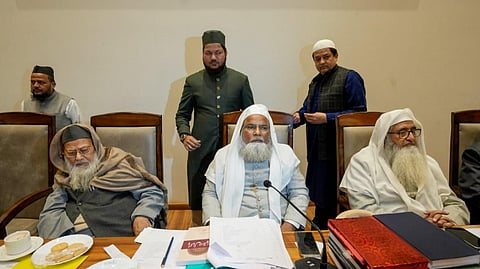

The All India Muslim Personal Law Board on Monday said it would soon come out with a comprehensive document on the "deteriorating condition" of Muslims in the country and launch a nationwide movement against the social and political marginalisation of the community.
The Board made the announcement a day after a meeting of its executive committee. Briefing reporters on the decisions and deliberations at the meeting, AIMPLB spokesperson SQR Ilyas said the Board reviewed in detail the current situation facing the country and the Muslim community, and took a number of important decisions.
"These decisions relate in particular to the growing incidents of mob violence or lynching against Muslims in BJP-ruled states; demolition drives targeting Muslim homes and localities, against mosques and madrasas; bulldozer terrorism; attempts to make Vande Mataram compulsory in government functions and schools; implementation of uniform government-aided madrasas; developments concerning the Madhya Pradesh High Court Civil Code in various states; and the recent judgment regarding the Kamal Maula Mosque," he said.
The Executive Committee expressed grave concern over the "rapidly deteriorating situation in BJP-administered states, the country and the Muslim community", he said.
The committee stated that Muslims' lives, property, honour and dignity, mosques, madrasas, graveyards, personal law, fundamental rights, and even their faith and beliefs are under continuous attack.
"We are unhappy with all parties, including the Congress. None of them raises issues of Muslims strongly," Ilyas said, when asked about Rahul Gandhi's reported remarks that if the issue pertains to Muslims, the community be specifically mentioned and not a generalised reference to minorities be made.
The Executive Committee decided that a comprehensive document would be prepared and published on the "deteriorating condition of the Muslim community, communal tensions and violations of fundamental rights, so as to awaken the conscience of the people," he said.
"With regard to the Kamal Maula Mosque case, the Executive Committee expressed deep concern over the Madhya Pradesh High Court's judgment, stating that there were historical evidence, revenue records, and colonial-era official documents. The judgment is contrary to centuries-old Muslim tradition of worship at the site. Furthermore, it is also inconsistent with the spirit of the Places of Worship Act, 1991," Ilyas said.
The Executive Committee welcomed the Kamal Maula Mosque Committee's challenge of the judgment in the Supreme Court, and resolved that the AIMPLB would extend every possible assistance to the Mosque Committee in their legal struggle, he said.
The Executive Committee declared that attempts to make Vande Mataram compulsory are contrary to Article 25 of the Constitution of India, Ilyas said.
The Board welcomed the Calcutta High Court's interim order staying the government directive requiring the singing of Vande Mataram in madrasas, he said.
The Executive Committee also expressed serious concern over the ongoing legislative efforts in BJP-ruled states in the name of the Uniform Civil Code (UCC), Ilyas said.
The meeting noted that after Uttarakhand and Gujarat, preparations are now underway to implement the UCC in Assam, Madhya Pradesh and Maharashtra as well.
The Board clarified that the Uniform Civil Code is not a mandatory constitutional command that courts are bound to enforce; rather, it is a non-binding guiding principle included among the Directive Principles of State Policy.
The Executive Committee further resolved that, against the social and political marginalisation of Muslims, violation of constitutional norms, the promotion of hatred and hostility, the damage to communal harmony, attacks on life, property, honour and dignity of Muslims and the demolition of mosques and madrasas, the Board will launch a nationwide movement in partnership with justice-loving, democracy-loving, and peace-loving sections of society, Ilyas said.
For this purpose, an Action Committee is being constituted, he said, adding that the movement may begin by July end.
The Executive Committee meeting on Sunday was presided over by AIMPLB president Maulana Khalid Saifullah Rahmani, and the proceedings were conducted by general secretary Maulana Fazlur Rahim Muiaddidi.
Executive Committee members from across the country attended the meeting.
(With Inputs from PTI)
