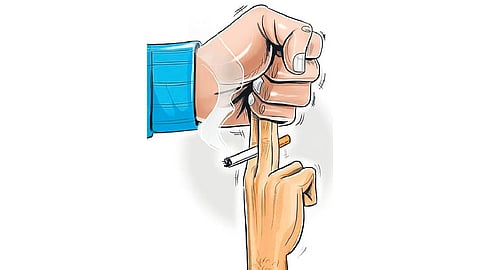

NEW DELHI: Liquor consumption among men, including in Bihar, which has imposed prohibition on it’s consumption, have gone up, while more and more women in India are taking up tobacco, according to the NFHS-6 (2023-24) data.
As many as 13 states and UTs, including Telangana, Uttar Pradesh and Puducherry, report an increase in any tobacco use among women in the age group of 15 years and above as compared to the National Family Health Survey -5 (2019-21).
This is despite that nationally there is a slight dip – from 8.9% to 8.4% - in women using tobacco of any kind. The same applies to men, too. Tobacco usage among men went down from 38.0% to 36.3%, as per the National Family Health Survey-6.
However, in many states and UTs, usage of tobacco, which is the single largest preventable cause of both cancer and cardiovascular disease (CVD) in India, is high among both men and women.
According to Dr Shalini Singh, Director, Indian Council of Medical Research-National Institute of Cancer Prevention and Research, Noida (ICMR-NICPR), a national average that appears favourable can mask subnational crises.
“Tobacco control policy must be disaggregated to the state and district level. We need state-specific and most importantly district-level burden assessments and tailored interventions, not one-size-fits-all national targets,” she told this paper.
What is worrisome is that the use of tobacco, both smoked and smokeless, has seen a rise among women, more so among rural women, in many states, including Telangana and Puducherry.
The states which are seeing a rise are: Arunachal Pradesh (from 18.8% to 19.1%), Chhattisgarh (from 17.3% to 18.7%), Goa (from 2.6% to 3.1%), Himachal Pradesh (from 1.7% to 1.9%), Madhya Pradesh (from 10.3% to 11.6%), Meghalaya (from 28.3% to 34.6%), Nagaland (13.7% to 17.4%), Punjab (from 0.4% to 0.5%), Sikkim (from 11.6% to13.1%), Telangana (5.6% to 5.9%), Uttar Pradesh (from 8.5% to 9.6%), West Bengal (from 10.8% to 11.2%) and Puducherry (from 2.6% to 4.1%).
“The rise in tobacco use among women in a few states is a serious public health signal that demands urgent attention,” Dr Singh said.
“Tobacco use during pregnancy is associated with adverse birth outcomes, including low birth weight, preterm birth, and increased infant mortality. The previous rounds of NFHS data showed high prevalence of smokeless tobacco use among pregnant women in many central, east and north-eastern states, a deeply alarming finding for both maternal and child health,” she added.
Dr Singh said the rise in female tobacco use in states calls for gender-sensitive tobacco control strategies, including targeted IEC campaigns, inclusion of tobacco cessation in maternal and reproductive health programmes, and stronger regulation of smokeless tobacco products marketed implicitly or explicitly to women.
It is, however, not that men are not smoking.
In 10 states, it is higher than the national average. These are: Arunachal Pradesh (from 50.3% to 51.4%), Chhattisgarh (from 43.1% to 45.3%), Madhya Pradesh (from 46.4% to 47.7%), Mizoram (from 73.1% to 73.6%), Nagaland (from 48.4 % to 51.2%), Punjab (from 12.9% to 13.9%), Uttar Pradesh (44.0% to 45.2%) Uttarakhand (from 33.7% to 33.8%), Chandigarh (from 11.9% to15.1%), Lakshadweep (from 28.5% to 29.5%).
Liquor consumption among men aged 15 years and above has seen a rise both nationally (from 18.7% to 18.9%) and in as many as 14 states and UTs.
These states includes: Andhra Pradesh (from 23.1% to 23.3%), Bihar (from 15.4% to 16.5%), Chhattisgarh (from 34.7% to 38.3%), Haryana (from 16.0% to 17.5%), Kerala (from 19.9% to 22.7%), Madhya Pradesh (from 17.0% to 18.5%), Nagaland (from 23.9% to 26.9%), Punjab (22.8% to 22.9%), Sikkim (from 39.9 to 42.2%), Telangana (from 43.4% to 43.9%), Uttar Pradesh (14.5% to 18.7%), Uttarakhand (from 25.5% to 27.2%), Chandigarh (0.3% to 1.1%), and Lakshadweep (from 0.4% to 0.6%).
Although nationally, consumption of liquor has slightly dipped among women from 1.3% to 1.1%, in eight states it has gone up.
These states are: Andhra Pradesh (0.5% to 0.6%), Chhattisgarh (4.9% to 5.7%), Kerala (0.2% to 0.3%), Madhya Pradesh (1.0% to 1.2%), Nagaland (from 0.9% to 1.6%), Sikkim (from 16.2% to 19.9%), Telangana (from 6.7% to 7.1%) and Chandigarh (from 0.3% to 1.1%).
Interestingly, dry states like Bihar, Nagaland and Mizoram, liquor consumption has seen a hike. The impact of liquor prohibition can only be seen in Gujarat among both men ( from 5.8 % to 5.2%) and women (from 0.6% to 0.3%).
In fact, men and women in rural India are consuming both liquor and tobacco more than those living in urban pockets.
Dr Singh said this is mainly due to lower literacy and health awareness, limited access to healthcare and cessation services, weaker enforcement of tobacco and alcohol regulations, higher availability and lower cost of products (particularly bidis, khaini, country liquor), and a higher proportion of physically demanding occupations where substance use is socially normalised as a coping mechanism.
“It also reflects the sharp urban bias in NCD prevention infrastructure. Cessation clinics, counselling services, and NCD screening camps are overwhelmingly concentrated in urban and peri-urban health facilities,” said the top scientist.
“The rural data from NFHS-6 make a compelling case for integrating tobacco and alcohol use screening and brief counselling into the work of frontline health workers and embedding cessation support into Ayushman Bharat–Health and Wellness Centres (AB-HWCs),” Dr Singh she further added.
“The evidence base is unambiguous that tobacco and alcohol are among the leading modifiable risk factors for India's growing NCD burden, including cardiovascular diseases and cancers. A comprehensive, multi-pronged response is required,” she said.
