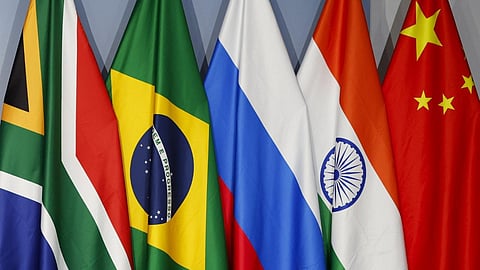

India assumed the BRICS Chairship on 1 January 2026 under the theme “Building for Resilience, Innovation, Cooperation and Sustainability.” On the women’s track, our contribution is a specific one. We are not bringing merely a slogan or a gallery of success stories to admire. We are bringing a working architecture, one that has reached hundreds of millions of women, and one that does not end with India but begins there, ready to be built upon wherever it travels.
That distinction is the point. For more than a decade, under the leadership of Hon’ble Prime Minister Shri Narendra Modi, India has pursued women-led development as a national mission, on a scale few countries can match. During our G20 Presidency in 2023, India helped shift the global vocabulary from “women’s development” to “women-led development,” not a change of phrase but a change of premise, from treating women as beneficiaries to treating them as decision-makers. The question we bring to Kochi is the one that follows that shift: once the promise is made, how do you deliver it, at scale, to the last woman in the last village? India has spent ten years answering that in practice rather than merely in principle.
This disposition is not new to Bharat; it is old. Long before the language of development, our Sanskriti envisioned the feminine as the very source of power, knowledge, and prosperity, the three faculties on which any society rises, revered as the Goddesses Durga, Saraswati, and Lakshmi. Divine power itself is named Shakti, and an oft-quoted Sanskrit verse holds that where women are honoured, the Gods themselves rejoice. Nor was this veneration only symbolic: women seers such as Lopamudra and Ghosha composed hymns of the Rig Veda, and philosophers such as Gargi and Maitreyi held their own in the great debates of the Upanishads. For Bharat, then, women-led development is not a borrowed idea but the contemporary form of an ancient one.
Begin with decision-making itself. Nearly half of all elected representatives in India’s Panchayati Raj Institutions are women, among the largest pools of elected women leaders anywhere, and the Nari Shakti Vandan Adhiniyam, 2023, reserves a third of the seats in Parliament and the State Assemblies for women. Representation is not where women-led development ends; it is where it begins. A model that delivers services to women but excludes them from the decisions that shape those services is not women-led at all.
The delivery architecture rests on three components that work only in combination. The first is reach: Digital Public Infrastructure places benefits directly in women’s hands, with Aadhaar-linked transfers removing the intermediaries that once diverted support before it arrived. The Pradhan Mantri Matru Vandana Yojana shows this reach in practice; over 4.26 crore mothers have received more than `20,060 crore in maternity benefits transferred directly to their Aadhaar-seeded accounts.
The second is institutions: under DAY-NRLM, more than 10.05 crore rural women have been organised into over 90.90 lakh Self-Help Groups, the largest network of women-led community institutions in the world. The third is mobility, a deliberate path upward rather than a permanent seat at the bottom of the value chain. India now deploys 65,949 SHG women as Business Correspondent Agents, the BC Sakhis, who carry deposit, credit, remittance, and pension services into remote areas. The woman who once queued for a benefit now delivers it.
Together, these turn participation into income and ownership. Under the Lakhpati Didi initiative, 1.48 crore SHG women had reached an annual income of at least `1 lakh by June 2025, and a National Campaign on Entrepreneurship launched in January 2026 aims to train 50 lakh more through 50,000 Community Resource Persons.
The same upward path runs through formal enterprise: 69 per cent of loans under PMMY and 84 per cent of Stand-Up India beneficiaries are women, and of the 2.12 lakh startups recognised by DPIIT, more than 1.02 lakh have at least one-woman Director or partner, many of them in smaller cities rather than the metros. What we offer BRICS is not these brand names but the sequence beneath them: reach first, then institutions, then a structured route from beneficiary to entrepreneur.
The numbers track this shift. India’s female labour force participation has risen from 23.3 per cent in 2017-18 to 41.7 per cent in 2023-24, and female unemployment has fallen from 5.6 to 3.2 per cent over the same period. With more women now in the workforce than ever before, our focus is turning to the next stage further improving the quality and income of their work.
This year’s women’s track has identified four priority areas, and one maps directly onto our experience: the role of women in climate action, food security, and nutrition. Here, the evidence is unambiguous: when women participate in decision-making, nutrition improves, and communities absorb shocks better. This is not abstract.
Women farmers in Jharkhand hold the knowledge of seed varieties that survive dry spells; women pastoralists in Rajasthan know the migration routes that carry livestock through drought. India’s task has been to build institutions that use this expertise rather than bypass it.
Mission Poshan 2.0 runs through the Anganwadi network, staffed by women who are its trusted last mile; climate adaptation runs the same way, from the high-altitude water-harvesting structures built by women in Ladakh to the mangrove-protection committees on the Odisha coast.
And women increasingly operate the technology of adaptation rather than merely receive it: under the Namo Drone Didi scheme, SHG women are trained to fly agricultural drones—a deliberate move into higher-skilled, higher-income work.
One thread is distinctly India’s own. Through One District One Product, now spanning 1,102 products across 761 districts, women’s collectives turn local specialties — handlooms, GI-tagged crafts, regional foods into branded, increasingly export-bound goods, with the State laying the market rails: reserved retail space at airports under the AVSAR scheme and a dedicated GeM storefront for women-led enterprises under Vocal for Local. This is sustainability in its most literal sense — local materials, local skills and local supply chains that keep value inside the community and a form of growth that does not require a woman to leave her district to reach a market.
Under the visionary leadership of Hon’ble Prime Minister Shri Narendra Modi, women-led development is not just an aspiration a government announces; it is a system it builds, component by component, until it reaches the last woman it was meant for. At the Ministerial meeting in Kochi this July,
India will present this architecture as a contribution, not a prescription offered for what others might learn from it and adapt to conditions of their own.That system, and the evidence that it works, is what India brings to BRICS. The exchange runs both ways: India comes to Kochi ready to learn from the best practices its BRICS partners bring, and to share its own.
