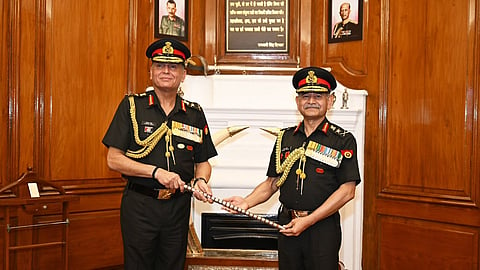

NEW DELHI: General Dhiraj Seth took over as the 31st Chief of the Army Staff (COAS) on Tuesday, succeeding General Upendra Dwivedi, who retired after more than four decades of service. He assumed charge on Tuesday afternoon, becoming the first officer from the Armoured Corps to head the Army since General Shankar Roychowdhury in 1997.
General Seth takes command of the 1.3-million strong force at a time when it is implementing a major restructuring even as several modernisation programmes remain pending.
Commissioned into the 2nd Lancers (Gardner’s Horse) in December 1986, the NDA and IMA alumnus takes over the hot seat after a brief stint as Vice Chief since April 1.
In a rare instance of a military legacy, Gen Seth follows in the footsteps of his father, Lt Gen Krishna Mohan Seth, a former Adjutant General and even went on to command the same Bhopal-based XXI “Sudarshan Chakra” Strike Corps that his father had once led.
Gen Seth also brings a rare operational pedigree to the top job, having commanded two operational Army Commands as an Army Commander, the Jaipur-based South Western Command and the Pune-based Southern Command, giving him sustained strategic oversight along the western front facing Pakistan for over two-and-a-half years.
His earlier command tenures span an armoured regiment in the desert sector, an armoured brigade in a developed sector and a counter-insurgency force in J&K, while his staff stints, as Colonel (Capability Development, Mechanised Forces) and Brigadier (Perspective Planning and Acquisition), were closely linked to the Army’s Long-Term Integrated Perspective Plan.
The new chief takes charge amid the Army’s sweeping post-Operation Sindoor reorganisation, with the conflict having underlined the growing role of drones, precision strikes, layered air defence and networked warfare in future battles.
The drive cuts across the combat arms, each raising its own drone and specialist formations under different names. For instance, Ashni platoons in the Infantry, Shaktibaan regiments and Divyastra batteries in the Artillery, the Shaurya Squadrons in the Armoured Corps and the newly announced Baaz battalions in the Army Aviation Corps, alongside the Bhairav light commando battalions and the all-arms Rudra Brigades.
A tank man himself, Gen Seth comes to the job with a direct hand in dragging the Armoured Corps into this drone age. The Shaurya Squadrons, drone sub-units now being embedded within armoured regiments to sharpen tank warfare, were first validated by his Sudarshan Chakra Corps under his command.
But Gen Seth also takes over with several key modernisation programmes still a work in progress. Infantry modernisation remains uneven, with the AK-203 rifle only gradually replacing the vintage INSAS, even as carbines, sniper rifles, night-fighting equipment and anti-tank guided missiles continue to move through acquisition at varying speeds.
Closest to his own arm, the long-awaited renewal of the Armoured Corps’ tank fleet is still years away. The Future Ready Combat Vehicle (FRCV) or Project Ranjeet, meant to replace around 1,770 ageing T-72 tanks, remains in the development and acquisition pipeline, with induction not expected before 2030. The Future Infantry Combat Vehicle (FICV), intended to replace the BMP-2 fleet, has also seen repeated delays over the years
The bottlenecks, as officials acknowledge, remain the familiar ones, tight capital budgets, cost and time overruns in DRDO and PSU projects and a private defence industry still not achieving a level playing field.
Looming over it all is the unfinished move towards theaterisation, with the long-pending creation of integrated tri-service theatre commands still snagged on differences over resources and command-and-control structures.
