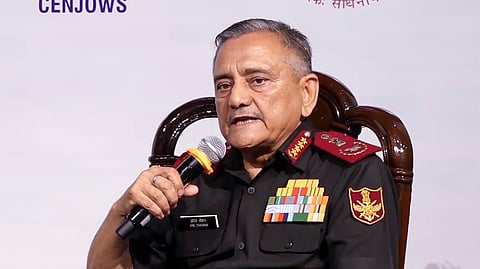

NEW DELHI: Outgoing Chief of Defence Staff, Gen Anil Chauhan, on Thursday said fears over any service losing relevance under India’s proposed theatre command structure were misplaced, asserting that the biggest challenge in pursuing military integration reforms was changing entrenched mindsets within the three services.
“Structural change is not a challenge. The challenge was always about changing mindsets,” he said at a fireside chat organised by the Centre for Joint Warfare Studies (CENJOWS) in the capital.
“No one is reducing the relevance of a particular service, but things have to be done together,” the CDS said, while acknowledging that “protectionism” and resistance among services were natural during such large-scale reforms.
The CDS said he personally addressed nearly 90 to 100 talks at military institutions, reaching mid-level officers, to build acceptance for the joint warfighting concept. “When people understand that we are preparing for future wars of multi-domain character, they realise everyone will have to work together,” he said.
The Army and Navy have publicly backed the move, describing greater jointness and theaterisation as “inevitable” for future warfare. The Indian Air Force, however, has raised concerns over the geographic segmentation of air power, particularly given its limited fighter strength of 29 squadrons.
It is learnt that one proposal under discussion involves retaining limited high-value assets such as Airborne Warning and Control Systems (AWACS), aerial refuellers and electronic warfare aircraft under centralised national control at Air Headquarters in New Delhi, rather than parcelling them out to individual theatre commands.
Gen Chauhan’s remarks on Thursday appeared aimed squarely at addressing those concerns, with the CDS repeatedly stressing that theaterisation was about fighting together more effectively and not about diminishing any service’s role or capability.
Currently, three proposals on the integrated theatre commands have been submitted to the defence ministry for vetting before being taken up by higher political authorities, including the Cabinet Committee on Security.
Significantly, India is also set to have a fully operational tri-service Joint Operations Centre (JOC) by the end of May in the capital. On this, the CDS said that fully standing up the JOC would require “500 to 2,000 additional personnel”, all of whom would have to be sourced through internal optimisation and restructuring.
Gen Chauhan also called the proposed Data Command the next frontier of military reforms, but conceded that work on the proposal had remained incomplete owing to operational pressures and competing priorities during his tenure.
Referring to Operation Sindoor, the CDS said India had dominated the “escalation matrix” across all four days of the operation because of superior battlefield transparency and situational awareness generated through integrated systems.
“We knew what had happened on every strike and every mission. The adversary did not have that level of situational awareness,” he said, describing the operation as largely non-contact and non-kinetic in character.
Calling reforms a “continuous process”, Gen Chauhan, who demits office shortly, expressed confidence that future generations of officers raised in a tri-service environment would carry the transformation forward at a faster pace. “If you are static and don’t reform yourself, then you will become extinct,” he said.
