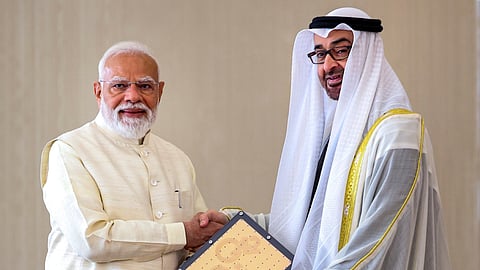

India and the UAE on Friday signed a series of major agreements in the areas of energy, defence, trade, shipping and advanced technology, while Abu Dhabi also announced investments worth USD 5 billion in India during Prime Minister Narendra Modi’s visit to the Gulf nation.
The agreements were finalised during Modi’s talks with UAE President Sheikh Mohamed bin Zayed Al Nahyan in Abu Dhabi, the first stop of the prime minister’s five-nation tour.
A key agreement signed between Indian Strategic Petroleum Reserves Limited and Abu Dhabi National Oil Company (ADNOC) aims to strengthen India’s energy security through strategic collaboration on petroleum reserves and possible cooperation in liquefied natural gas (LNG) and liquefied petroleum gas (LPG) storage facilities.
According to an official statement, the agreement will increase the UAE’s participation in India’s strategic petroleum reserves to 30 million barrels and support the creation of strategic gas reserves in the country.
The two sides also signed a separate long-term LPG supply agreement to ensure stable availability of cooking gas widely used in India.
India and the UAE further inked a framework agreement for a strategic defence partnership focused on defence industrial collaboration, technology sharing, innovation and regional security cooperation.
“The two sides have agreed on deepening defence industrial collaboration and cooperation on innovation and advanced technology, training, exercises, maritime security, cyber defence, secure communications and information exchange,” an official statement said.
The UAE also announced investments worth USD 5 billion in India, a move the Ministry of External Affairs (MEA) said reflected Abu Dhabi’s “sustained commitment to India’s development and growth story”.
Modi described the agreements signed during the visit as “pivotal” for cooperation in sectors such as energy, defence, infrastructure, shipping and advanced technologies.
He said the agreements would provide a fresh boost to the India-UAE Comprehensive Strategic Partnership.
In another major development, Indian Oil Corporation Limited and ADNOC signed an agreement aimed at expanding cooperation in LPG trade, including long-term supply arrangements.
The two countries also signed agreements for setting up a ship repair centre at Vadinar in Gujarat, cooperation in ports and coastal infrastructure, and skill development in ship repair.
The MEA said both sides also signed a term sheet for establishing a supercomputing cluster to strengthen India’s artificial intelligence and high-performance computing capabilities.
The two leaders also welcomed the operationalisation of a virtual trade corridor connecting customs and port authorities of both countries to streamline cargo movement, reduce logistics costs and cut transit times.
The discussions took place amid concerns over disruptions to crude oil and gas supplies due to the ongoing conflict in West Asia, particularly around the Strait of Hormuz, a critical route for India’s energy imports.
During the talks, the two leaders also exchanged views on regional developments.
“We condemn the attacks on the UAE,” Modi said in his opening remarks, adding that “the way UAE has been targeted is not acceptable”.
Praising the UAE leadership for handling the situation “with restraint”, Modi said India was ready to extend “all possible support” to bring peace in West Asia.
Earlier in the day, Sheikh Mohamed bin Zayed Al Nahyan personally received Modi at Abu Dhabi airport, where the prime minister was accorded a ceremonial guard of honour. Modi’s aircraft was also escorted by UAE military jets in a special gesture.
Before departing for the Netherlands, Modi described the visit as “short but highly productive”, saying he had held extensive discussions on ways to further deepen the India-UAE Comprehensive Strategic Partnership.
(With PTI inputs)
