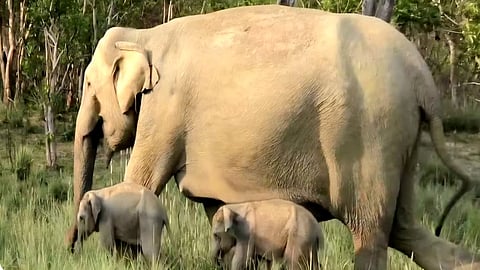

DEHRADUN: In a rare wildlife event, a female elephant has given birth to healthy twin calves in the Garjiya tourism zone of Corbett National Park, marking an extraordinary occurrence that has drawn the attention of wildlife experts, park officials and nature enthusiasts.
The mother elephant and her two calves were spotted during a jungle safari by noted wildlife enthusiast Sanjay Chimwal, who captured the sighting on video. The footage has since gone viral, with experts describing it as a remarkable sign of the region’s thriving ecosystem.
Dr Saket Badola, Director of Corbett Tiger Reserve, said the successful birth reflected the strength of the landscape.
"The Corbett Tiger Reserve and the entire Shivalik Elephant Reserve are crucial for elephant conservation," Dr Badola told TNIE. "Uttarakhand hosts a significant population of elephants in the Corbett landscape, with over 1,200 individuals recorded. The birth of twin calves is a positive indicator of a healthy, secure wildlife environment."
He further elaborated on the biological rarity of the event, stating, "Elephants have a gestation period of approximately 22 to 24 months. After such a long period of development, the arrival of twins is a unique event. Generally, elephants give birth to a single calf, making the birth and survival of twins an exceptional anomaly."
Twin births among elephants are extremely rare, occurring in less than one per cent of all pregnancies, with estimates generally placing the occurrence between 0.5 and one per cent.
Wildlife expert and former deputy director of the state forest department, Ranganath Pandey, who has conducted extensive studies on wild elephants, explained the significance of the birth.
"Statistically, twins occur in less than 1% of all elephant births. Survival is the key challenge; in the wild, twin births are often biologically demanding for the mother. Because elephants have long gestation periods and produce a significant amount of milk, supporting two calves simultaneously places an immense nutritional strain on the mother."
Wildlife enthusiast Deepankar Khulbe echoed these sentiments, noting that for a mother elephant to successfully carry two calves to term and care for them after a two year gestation period is both challenging and awe inspiring.
The sighting has sparked increased tourist interest in the Garjiya zone, with local operators reporting a surge in bookings from visitors hoping to catch a glimpse of the rare elephant family. Forest officials, however, remain focused on ensuring the mother and calves have sufficient space and minimal disturbance.
For conservationists, the event is seen as evidence of the effectiveness of habitat protection efforts in Corbett. By maintaining secure forest zones, ensuring adequate food availability and providing a stable environment, the park continues to support one of India’s most vital elephant populations.
The sighting follows similar twin elephant births recorded in Madhya Pradesh’s Panna Tiger Reserve, reinforcing nature’s capacity to surprise. For now, Corbett’s twin calves stand as a hopeful sign for the future of elephant conservation in the region.
