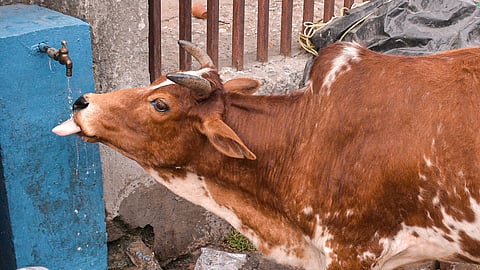

Days before Eid-ul-Azha (Bakrid), several Muslim organisations -- particulary in Uttar Pradesh -- have backed a call by Maulana Arshad Madani, president of the Jamiat Ulama-e-Hind (Arshad Madani faction), to declare the cow India’s "national animal."
The groups say such a move could help curb the political exploitation of cow slaughter and prevent incidents of mob lynching and violence carried out in its name. Some organisations are seeking to build a broader consensus within the Muslim community on the issue, while others plan to raise the matter with the prime minister and chief minister.
The demand is particularly significant in Uttar Pradesh, India’s most populous state with a sizeable Muslim population, where similar calls have traditionally come from Hindu organisations.
Raised during this final Eid-ul-Azha preceding the 2027 Uttar Pradesh Assembly elections, this voice emerging from the Muslim community carries its own distinct significance.
Maulana Shahabuddin Razvi, National President of the All India Muslim Jamaat, wholeheartedly supported Madani's demand to designate the cow as the 'National Animal'.
Speaking to PTI, Razvi said that his objective would be to forge a consensus among various Muslim organisations on this matter.
To this end, a meeting of key representatives from prominent Muslim organisations will soon be convened in Delhi, where a joint memorandum of demands will be drafted and subsequently submitted to the country's top leadership, including Prime Minister Narendra Modi.
Razvi asserted that the government should fulfil this demand immediately, as doing so would not only bring uniformity to the government's policies regarding cow slaughter across the entire nation but would also help eradicate incidents of mob lynching and other acts of oppression perpetrated in the name of cow slaughter.
Siraj Qureshi, President of the All India Qureshi Jamaat -- a prominent organisation of the Qureshi community involved in the meat trade -- said that the issue of cow sacrifice has once again become a heated topic in political circles ahead of Eid-ul-Azha (Bakrid), and the unfolding events in West Bengal serve as the latest example of this trend.
Openly supporting the demand to declare the cow the national animal, he affirmed that, if necessary, his organisation would seek a meeting with the prime minister in this regard.
Qureshi noted that his organisation has long been advocating for the declaration of the cow as the national animal. However, to date, no government has taken any concrete initiative in this direction.
Speaking on the matter, National General Secretary of the All India Shia Personal Law Board, Maulana Yasoob Abbas, remarked that while the demand to declare the cow as the national animal is valid, it is the government's responsibility to act upon it with sincerity.
He asserted that the government's intent regarding the cow should be clearly reflected in its policies, ensuring a consistent approach, rather than a situation where cows are consumed without restriction in some states, while lives are taken in the name of the cow in others.
Endorsing Madani's demand, National Vice President of the Indian Union Muslim League Kausar Hayat Khan said it is technically sound and that the government should fulfil it with absolute sincerity.
When asked about Muslim organisations uniting on a common platform to forcefully raise this demand, Khan observed that this cause could only gain full momentum if all Muslim organisations came forward together.
Criticising the government's policies regarding the animal, Khan pointed out that beef is still consumed without restriction in Goa, Assam, and various northeastern states.
He highlighted the irony that most of these states are governed by the very same Bharatiya Janata Party, which, in states like Uttar Pradesh and Uttarakhand, as well as now in West Bengal, adopts a divergent stance by politicising the issue of cow slaughter.
Maulana Khalid Rashid Farangi Mahali, a senior executive member of the All India Muslim Personal Law Board, said, "Our Hindu brethren hold religious sentiments regarding the cow; therefore, out of respect for their feelings, the cow should be declared the national animal."
Demanding uniformity in laws regarding cow slaughter across the entire country, Maulana Rashid asserted that a single, uniform law against cow slaughter should be implemented nationwide.
Responding to a question regarding the possibility of a coordinated effort by Muslim organisations to have the cow declared the national animal, he remarked that all religious organisations should come forward in this direction.
Maulana Arshad Madani, President of the Jamiat Ulama-e-Hind (AM faction), reiterated his long-standing demand in a statement issued last Wednesday, just days before Bakrid, the second major festival for Muslims.
He asserted that the cow should be accorded the status of the national animal, and provisions for the strictest possible action should be enacted against those involved in the purchase and sale of cows for slaughter, as well as those trading in cow meat.
Highlighting that this demand is not new, Maulana Kaab Rashidi, the legal advisor for the organisation's Uttar Pradesh unit, pointed out that Madani had made a similar demand during an All-Faith Conference held in Mumbai in 2014.
He added that in recent years, various Hindu organisations have also intensified their demands for declaring the cow the national animal. However, no visible progress appears to have been made by the government in this regard.
The issue of cow slaughter has held significant importance, particularly in the politics of North India, and governments have often adopted a strict stance regarding it.
In 2017, the Uttar Pradesh government shut down all illegal slaughterhouses in an alleged effort to strictly curb cow slaughter.
However, licenses were subsequently issued, subject to stringent regulations, specifically for the trade of buffalo meat.
(With inputs from PTI)
