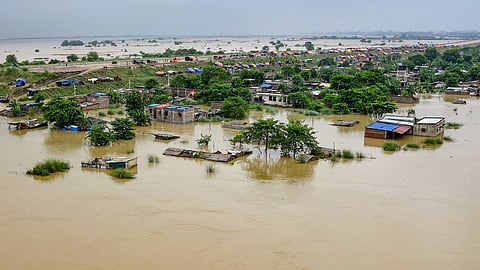

NEW DELHI: The Ministry of Jalshakti has initiated administrative and institutional changes ahead of the monsoon in 2026 to advance its goal of achieving “zero casualties and minimal property damage” during flood season.
As part of this process, the Chairman of the Ganga Flood Control Commission will be relocated from its headquarters in Patna to serve as a member (floods) in the Central Water Commission in New Delhi, under the overall oversight of the Chairman of the CWC, who is also the ex-officio Secretary to the Government of India.
Along with him, the Member (Planning) of the Ganga Flood Control Commission will transition to the role of Chief Engineer (Flood Appraisal) in the CWC in New Delhi.
A senior officer involved in the development justified this change by highlighting a shift in strategy.
“This represents a shift from a reactive relief approach to a proactive one. It will further strengthen the government’s focus on prevention-based disaster management”, he stated.
Another officer familiar with the situation suggested that relocating to Delhi could enhance coordination efforts before the monsoon season. However, he noted that, with all Gangetic plains now under ruling BJP governance, the states are likely more agreeable to the move from Patna to Delhi. In the past, states like Bengal and Bihar might not have supported this shift even if Centre wanted it.
Floods are one of the most significant natural disasters in India, causing extensive damage to lives, property, agriculture, and infrastructure each year.
On average, floods affect approximately 7.3 million hectares of land annually and result in economic losses of nearly Rs 18,000 crore. While flood management is primarily a state responsibility, the central government provides catalytic, technical, and financial support to state governments to address these issues in an integrated manner.
The restructured body will also be tasked with preparing master plans for various river basins, excluding the Northeastern Region, which continues to be managed by the Brahmaputra Board. This new body will be authorised to conduct studies on river morphology and sedimentation to improve flood management planning.
Additionally, the new body will develop a dashboard called the "Flood Management Information System" to monitor all flood management efforts. This will include tracking completed and ongoing anti-erosion projects as well as identifying affected areas and populations across all states. Previously, the government also restructured the Brahmaputra Board (BB) to include Sikkim and West Bengal as members for the first time.
This reorganization aims to facilitate basin-wise planning and flood management in the Northeast region, including Sikkim and West Bengal, which are part of the Brahmaputra basin. Environmental activists in Sikkim have raised concern over inclusion of Sikkim in Board as it may renewed dam push in the hilly areas.
At the central government level, the flood issue is addressed by the CWC, GFCC, and BB, with the CWC serving as the apex technical organization involved in flood forecasting, appraisal of flood management schemes (excluding the Ganga basin), inundation modeling, and floodplain zoning.
