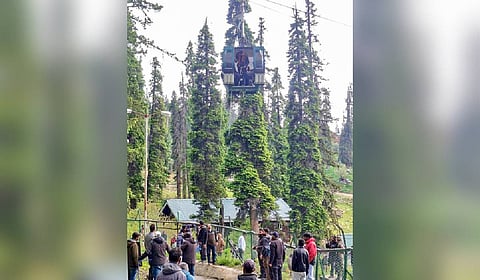

Hundreds of tourists were stranded for several hours after a technical malfunction disrupted operations of the Gulmarg Gondola cable car service in Jammu and Kashmir on Monday, triggering a massive rescue operation led by the Indian Army and multiple disaster response agencies.
The incident unfolded at Gulmarg, one of Kashmir’s most visited tourist destinations and home to one of the world’s highest operating cable car systems. Officials said the malfunction brought Gondola operations to a sudden halt during peak tourist movement, leaving dozens of cabins suspended mid-air above steep mountainous terrain.
The abrupt stoppage created panic among passengers, many of whom included families with children, elderly tourists, and visitors unfamiliar with high-altitude rescue conditions. Visuals circulating on social media showed anxious passengers trapped inside cabins for prolonged periods while rescue teams worked in difficult terrain to evacuate them safely.
According to officials, nearly 65 cabins were immobilised after the technical snag developed. Hundreds of tourists were believed to have been stranded across both phases of the Gondola service. The Gulmarg Gondola operates in two sections, with the first phase connecting Gulmarg to Kongdoori and the second phase linking Kongdoori to the Apharwat ridge, a major attraction for tourists and skiing enthusiasts.
Authorities immediately suspended operations of the cable car service after the malfunction was detected and activated emergency response protocols. A coordinated rescue operation involving the Indian Army, the Army’s High Altitude Warfare School, Jammu and Kashmir Police, the State Disaster Response Force, the National Disaster Response Force, and local civil administration was launched shortly afterwards.
Rescue teams faced significant challenges during the operation because of the difficult mountain terrain, changing weather conditions, strong winds, and the sheer number of passengers stranded inside suspended cabins. Officials said trained personnel used specialised mountain rescue techniques to access the cabins and evacuate passengers in a phased and controlled manner.
Army personnel played a central role in the rescue effort, particularly because of their expertise in high-altitude operations in Kashmir’s mountainous regions. Teams worked continuously to reassure frightened passengers while carrying out evacuations under strict safety protocols.
Initial updates from officials indicated that more than 100 passengers had been rescued from over 20 cabins during the early phase of the operation. As rescue efforts progressed, authorities confirmed that nearly 300 stranded tourists were eventually evacuated safely without any reported fatalities.
Officials repeatedly stressed that all cabins remained structurally stable throughout the incident. Authorities also appealed to the public not to panic and assured families that the situation was under control.
Jammu and Kashmir Chief Minister Omar Abdullah said the administration was closely monitoring developments and coordinating with rescue agencies on the ground. He stated that trained rescue teams had been deployed immediately and that all efforts were focused on ensuring the safe evacuation of stranded tourists.
Lieutenant Governor Manoj Sinha also reviewed the situation and directed senior officials, including top police officers and civil administration authorities, to oversee the rescue operation personally.
The incident led to tense and emotional scenes at the tourist site. Reports suggested that many passengers became distressed after being trapped for hours inside cabins suspended hundreds of feet above the ground. Families were seen waiting anxiously for updates as rescue teams continued operations cabin by cabin.
The Gulmarg Gondola is among the biggest attractions in Jammu and Kashmir and serves as a major driver of tourism in the region. Located in Baramulla district of north Kashmir, the cable car system attracts tourists from across India and abroad throughout the year, especially during the winter ski season and the summer tourist rush.
The Gondola is considered a crucial part of Kashmir’s tourism economy, offering access to snow-covered slopes, trekking routes, and panoramic mountain views. Heavy tourist footfall during peak travel seasons often places enormous operational pressure on tourism infrastructure in the region.
The malfunction has once again raised concerns about the maintenance and safety preparedness of high-altitude tourism infrastructure. Questions are now being raised about technical inspections, emergency evacuation readiness, passenger management, and operational safeguards during periods of heavy tourist activity.
Authorities said technical experts would inspect the Gondola system thoroughly before normal operations are resumed. Officials are expected to examine the precise cause of the malfunction, including whether weather conditions, technical failure, or operational issues contributed to the disruption.
The incident also highlighted the critical role played by the armed forces and disaster response agencies in emergency operations across Jammu and Kashmir’s mountainous terrain. Rescue personnel were widely praised for carrying out the evacuation without casualties despite challenging conditions.
Officials later confirmed that all stranded passengers had been brought to safety and that restoration work on the cable car system was underway. Further safety assessments are expected before the Gondola service resumes full-scale operations.
