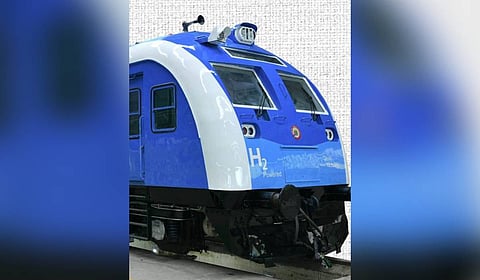

CHANDIGARH: The Ministry of Railways has approved the introduction of country's first fully indigenous 10-coach hydrogen DEMU (Diesel-Electric Multiple Unit) train.
The train is set to start regular operations between Jind and Sonepat in Haryana.
This marks a significant milestone in the country’s transition to cleaner and more sustainable railway technology.
As per a letter dated May 22, from the Director, Civil Engineering, Railway Board, Kishan Rawat to the Director General, Research Design and Standards Organisation, and General Manager, Northern Railway, the sanction of Rolling Stock has been processed for operation over a dedicated section Jind-Sonepat only, whereas the scheduled maintenance of the Trainset has been planned at Shakurbasti, Delhi.
The necessary authorization for the movement of the trainset from Jind-Shakurbasti-Jind in dead condition (Hauled by Loco) shall be ensured in accordance with extant codal provisions, said sources.
It also called for the provision of 24x7 manning for the control room, with complete access to the data log for the hydrogen refuelling cycle.
Necessary arrangements to ensure the proper security of the entire premises of the hydrogen plant and refuelling facility shall be made to prevent unauthorised access.
This train will run at the maximum speed of 75 kilometres per hour and the trial runs were conducted in March this year.
Also, a license has been granted for the filling and storage of Compressed Hydrogen Gas (CHG) in the Hydrogen Storage System from the Hydrogen Generation Unit for dispensing as automotive fuel at Jind, Haryana.
Initially, for three months, the train shall be accompanied by trained technical staff having competency in the hydrogen trainset to attend to en-route technical issues.
This hydrogen train stands out globally as the world’s longest hydrogen train on a broad-gauge system.
With a 10-coach configuration (2 Driving Power Cars and 8 passenger coaches), the total power output is 2400 kW (1200 kW per Driving Power Car).
The passenger capacity is up to 2,600 passengers, and it is designed for smooth operation on Indian tracks while maintaining high efficiency and safety standards.
Haryana Chief Minister Nayab Singh Saini has expressed gratitude to Prime Minister Narendra Modi and the Central Government for allotting the country’s first hydrogen fuel cell-based DEMU train to Haryana.
He said this is not only a historic achievement for Haryana but for the entire country, which will give India a new identity in the direction of modern, environment-friendly and future-oriented public transportation.
He said that the Railway Board has approved the operation of a 10-coach hydrogen fuel cell-based DPRS 1200-kilowatt DEMU train between Jind and Sonipat.
This train will run at a maximum speed of 75 kilometres per hour.
The Chief Minister said that this project will play an important role in making Haryana a leading centre of clean, safe and modern rail transport technology in the country.
Saini said that hydrogen-based trains will become a strong foundation for the future of transportation.
This will not only help reduce pollution but will also give a new direction to the use of green energy and alternative fuels.
"This Hydrogen DEMU train will prove to be a milestone, keeping future projects in view,’’ he said. The Ministry of Railways had allocated Rs 2,800 crore in the 2023–24 budget for hydrogen train development.
This funding supports research, design, testing, and the creation of necessary infrastructure for wider adoption across key routes.
Under the “Hydrogen for Heritage” project, Indian Railways plans to introduce 35 hydrogen-powered trains, primarily on heritage and hill routes.
Each train approximate cost Rs 80 crore and the infrastructure cost per route is around Rs 70 crore. This large-scale plan aims to promote sustainable tourism on sensitive routes while reducing the carbon footprint of Indian Railways.
