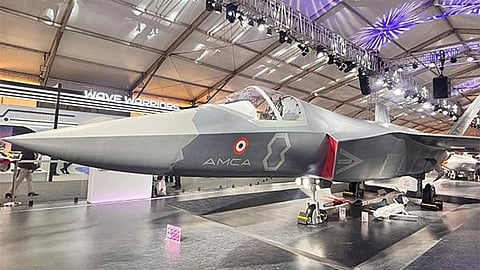

NEW DELHI: The government on Wednesday invited bids for India’s nearly Rs 15,000-crore Advanced Medium Combat Aircraft (AMCA) programme, with three shortlisted Indian firms and consortia set to compete for development of the country’s first indigenous fifth-generation stealth fighter.
The Request for Proposals (RFP), issued by the DRDO’s Aeronautical Development Agency (ADA), seeks detailed technical and commercial bids for five flying prototypes, a structural test specimen and the associated manufacturing and testing ecosystem.
The AMCA programme had earlier received Cabinet Committee on Security (CCS) approval for full-scale engineering development in early 2024.
The three contenders advancing in the race are Larsen and Toubro in partnership with Bharat Electronics Limited and Dynamatic Technologies, Tata Advanced Systems Limited which has bid independently, and Bharat Forge, which has teamed with state-run BEML and Data Patterns.
The shortlisted firms have around two months to submit their proposals, unless the deadline is extended.
As reported earlier, Hindustan Aeronautics Limited was eliminated at the financial evaluation stage. Concerns had emerged over HAL’s capacity to absorb yet another major programme alongside existing commitments. Its order book is already nearly eight times its annual turnover, driven by Tejas Mk-1A production, Su-30 upgrades and several other ongoing programmes.
After evaluation, the government will select the lowest qualifying bidder (L1), with contract negotiations expected to conclude by early 2027.
The winning firm must then float a new dedicated company exclusively for the AMCA programme within three months, with the contract signed with this new entity rather than the parent firm.
Once the contract is signed, the programme clock starts. The first prototype is expected to undertake taxi trials and maiden flight around 30 months later, placing the first flight around mid-to-late 2029 if timelines hold.
Four more prototypes will follow progressively through mid-2032, with the full flight-test campaign of nearly 1,800 sorties running till around 2034. Serial production can begin only after testing, certification, weapons integration and operational clearances are completed.
Subsequently, if the timelines hold then the AMCA is expected to enter IAF service around 2035.
Earlier this month, the defence minister Rajnath Singh laid the foundation stone for the AMCA manufacturing and flight-test facility at Puttaparthi in Andhra Pradesh.
The aircraft is being designed as a twin-engine, medium-weight stealth fighter with internal weapons bays, advanced sensors and multi-role capability spanning air superiority to deep precision strike missions.
The initial 40-aircraft Mk-1 variant will be powered by GE Aerospace F-414 engines, while the more advanced Mk-2 is planned around a higher-thrust indigenous engine, with French firm Safran likely to play a major role in its development.
The push for a fifth-gen fighter also comes against an increasingly evolving regional air combat environment. China already fields two fifth-generation fighters, the J-20 in PLA Air Force service since 2017 and the carrier-capable J-35, which entered service last year. The country has also flown two sixth-generation fighter prototypes,
Meanwhile, Pakistan signed a framework agreement in principle with Beijing in June last year for up to 40 J-35 export-variant fighters, with reports suggesting the Pakistan Air Force (PAF) could begin receiving the stealth jets by the end of this year.
The IAF is also assessing a proposal for 36 to 40 Russian Su-57E fighters as an interim bridge, with Moscow confirming discussions have reached an advanced technical stage.
