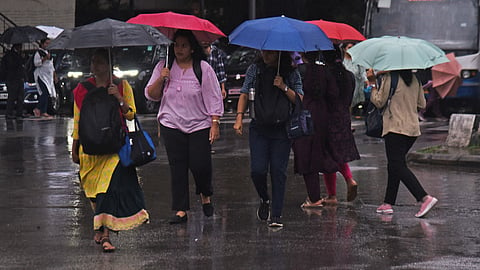

The Indian Meteorological Department (IMD) has revised its Southwest monsoon (June to September) prediction, lowering the expected rainfall to 90% of the Long Period Average (LPA), down from the previously forecasted 92%. The month of June is also expected to experience below-normal rainfall and an increased number of heatwave days.
The last time India received deficient rainfall was in 2014 and 2015, with 88% and 86%, respectively. Recently, India received below normal rainfall in 2018 (91%) and 2023(94%). These years were detrimental to agriculture as production dipped and the water crisis shot up.
In its second-stage Long-Range Forecast of the Monsoon rainfall 2026, the IMD indicated that India is heading towards one of the driest monsoon seasons of the decade. The country's monsoon core zone, which consist country’s rainfed agriculture areas in the country, is most likely to be receivedbelow 94% of the LPA, with a potential model error of ±4%.
Only East and North East India are expected to receive normal rainfall, in the range of 94-106% of the LPA. The rest of the country, including South Peninsula and Central India, is anticipated to receive below 94% of the LPA, while the northwest region is expected to receive below 92% of the LPA.
The region where IMD predicted monsoon shortfall is important for food security, which is already facing a fertiliser crisis due to the Iran war.
However, states like Jammu and Kashmir and the Ladakh region, Telangana, Central Andhra Pradesh, Central Odisha, Chhattisgarh and Northeast India will receive normal to above normal rainfall.
Additionally, the arrival of the monsoon has been delayed by a week. The IMD had initially forecast the monsoon to reach the Kerala coast by May 26, while the normal date for monsoon onset is June 1.
Scientists are also warning that the country may experience deficient rainfall, which is defined as below 89% of the LPA, while below-normal rainfall is categorised as between 90-95% of the LPA. The IMD further stated that a strong El Niño, abnormal warming of the East Pacific Ocean, is expected to emerge after the monsoon, while a weak to moderate El Niño will prevail during the monsoon season. El Niño is synonym to weakening of the Indian monsoon. There were 60% of El Niño years when India faced deficient rainfall.
Furthermore, June 2026 is likely to see below-normal rainfall, except in Telangana, Andhra Pradesh, Northeast India, and Jammu and Kashmir and Ladakh, with normal June rainfall averaging 166.9 mm.
Moreover, the IMD has reported an anticipated increase in the number of heatwave days in June. There could be 2-3 days with above-normal temperatures across the country, contributing to heatwave conditions.
The regions expected to experience above-normal heatwave days include parts of Uttar Pradesh, Haryana, Punjab, Bihar, Odisha, Chhattisgarh, Gujarat and Andhra Pradesh. Isolated regions of Maharashtra, Telangana, Himachal Pradesh, and Tamil Nadu. However, below-normal heatwave days are likely over Rajasthan and Jharkhand.
