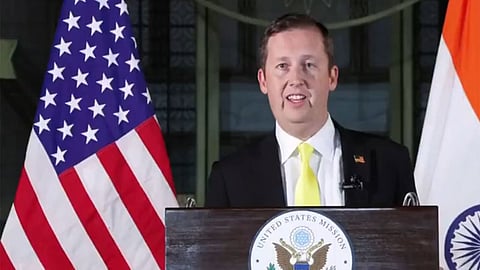

NEW DELHI: US ambassador to India Sergio Gor on Friday expressed optimism that an interim trade agreement between India and the United States would be signed shortly, saying negotiations were in the final stages.
Speaking at IIT Delhi on the theme ‘US-India Trust Initiative: Advancing Partnership in Research and Training’, Gor said teams from both countries were working to finalise the remaining details of the proposed agreement.
“President Trump’s goal is to facilitate bilateral trade in a way in which it creates unprecedented opportunities for American businesses and workers. Just last week India had sent a team to Washington DC to finalise the last one percent of that trade deal. Next week, we will welcome a US delegation here to continue those talks. We fully expect the new trade deal to be signed within the next few weeks and months,” he said.
Highlighting the growth in economic ties, Gor said bilateral trade between India and the US had risen from USD 20 billion to USD 220 billion in goods and services over the past two decades.
“It is not just the volume but it reflects deeper engagement and stronger economic integration,” he said.
Emphasising the strategic partnership between the two countries, the ambassador said critical and emerging technologies were reshaping the global balance of power.
“And I believe no partnership is better positioned to lead that charge than ours,” he said.
Gor said the Indo-US relationship must deliver tangible benefits for both nations and stressed that the Trump administration viewed India as a key global partner.
“One of the things the Trump administration has done is identifying the new centres of power. To me, to the President and the administration, the importance of India is now,” he said.
Referring to the ‘Transforming the Relationship Utilising Strategic Technology’ (TRUST) initiative launched by Prime Minister Narendra Modi and US President Donald Trump in February, Gor said the partnership had already delivered substantial progress.
The initiative focuses on cooperation between governments, academia and the private sector in areas such as defence, artificial intelligence, semiconductors, quantum technology, biotechnology, energy and space.
“We committed to developing a US-India AI infrastructure road map, identifying constraints to building, powering and financing, connecting large-scale US-origin AI infrastructure here in India,” he said.
The ambassador also highlighted growing American investments in India.
“Amazon expects to invest 35 billion into India by 2030 to advance AI-driven digitisation, export growth and job creation. Microsoft announced a 17 and a half billion investment here in India including the expansion of hyperscale cloud infrastructure,” he said.
He also praised the Indian government for introducing policy changes to facilitate investments by global technology firms.
Speaking about the pharmaceutical sector, Gor said India remained a trusted supplier of medicines to the United States.
“On pharmaceuticals, we import upto close to 40% of our generics from India. The reason is we trust India and they are critical, life saving ingredients in the US,” he said.
The ambassador also pointed to India’s growing space sector, noting that the Indian Space Research Organisation had launched 233 satellites, including those for US companies, over the last 20 years.
He added that India’s recent decision to launch 50 new satellites had created fresh opportunities for American firms, especially after allowing 100% foreign direct investment in the space sector since 2014.
