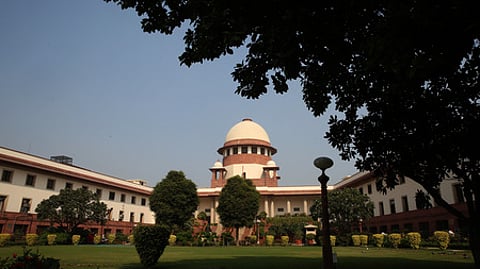

The Supreme Court has ruled that traffickers involved in the commercial sexual exploitation (CSE) of minors can be prosecuted under the stringent POCSO Act in addition to provisions of the Bharatiya Nyaya Sanhita (BNS) and the Immoral Traffic (Prevention) Act (ITPA).
A bench of Justices J B Pardiwala and R Mahadevan said the applicability of laws in trafficking cases depends on factors such as the victim’s age, the methods used by traffickers and the nature of exploitation.
The court passed the order while hearing a plea by NGO Prajwala seeking stronger measures to curb human trafficking and protect victims of commercial sexual exploitation.
Clarifying the legal framework, the bench said the consent of trafficking victims cannot be used as a defence in cases involving coercion, deception or abuse.
“The consent of a child victim of trafficking is irrelevant, regardless of whether or not ‘means’ have been used. Lack of consent is not an element of the crime of trafficking in persons.
“Thus, the focus should be firmly on the actions and intentions of the perpetrators, and once the elements of the crime of trafficking, including the use of one of the identified means (coercion, deception, etc.), are proven, any defence or allegation that the victim ‘consented’ should be deemed to be irrelevant,” the court said.
For adult victims, the bench said consent becomes immaterial if traffickers employ threats, force, coercion, abduction, fraud, deception, abuse of power or inducements to facilitate exploitation.
The court also observed that a person’s awareness of being employed in prostitution does not automatically rule out trafficking, as victims may initially consent to work but later face exploitative conditions.
“When the victim of trafficking for CSE is a child, the provisions of the POCSO Act may apply alongside Sections 143 and 144 BNS respectively and/or the provisions of ITPA,” the bench said.
It noted that Indian law treats every act of sexual exploitation involving a child as non-consensual and that the POCSO Act covers a range of offences, including sexual harassment, aggravated sexual assault and child sexual abuse material.
“Therefore, in all cases where the sexual exploitation of a child involves acts punishable under the POCSO Act, the perpetrators would be charged and prosecuted under it.
Once the POCSO Act is enacted, several aspects of the prosecution change significantly.
“The procedure for reporting the offence, recording the victim’s statement, and conducting the medical examination is governed by the specific provisions of the POCSO Act, which are designed to be more sensitive and protective of the child’s interests,” it said.
The bench stressed that rehabilitation of victims remains crucial, warning that survivors often return to the same vulnerable conditions without institutional support. It said meaningful rehabilitation is essential to uphold protections guaranteed under Articles 21 and 23 of the Constitution.
(With inputs from PTI)
