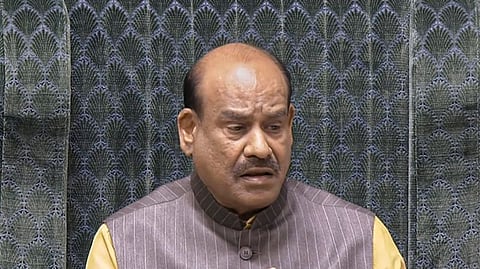

Lok Sabha Speaker Om Birla on Wednesday said disagreements and agreements were part of democracy but stressed that Parliament must hold meaningful debates and discussions without disruptions ahead of the Winter session.
"There should be fruitful debates. Agreements and disagreements are part of democracy. Only meaningful discussions can resolve all disagreements," Birla told reporters on the sidelines of the Conference of Chairpersons of the Public Accounts Committees (PACs) of Parliament and state and Union Territory legislatures.
The Winter session of Parliament is likely to begin either towards the end of this month or early next month.
Asked whether the Special Intensive Revision (SIR) of electoral rolls could figure in the session, Birla said the Business Advisory Committee (BAC) would decide the issues to be taken up in the House.
He also said he had not received any notice seeking the impeachment of Chief Election Commissioner Gyanesh Kumar.
The opposition has been protesting against the SIR exercise and demanding Kumar's resignation, raising the possibility of disruptions during the upcoming session.
Earlier, addressing the valedictory session of the two-day PAC conference, Birla stressed the need for effective legislative oversight to ensure that government funds were properly utilised and increased budgetary allocations translated into tangible outcomes.
He said public investment was rising across sectors, including education, healthcare, infrastructure, social welfare and rural development, leading to an increase in government expenditure and budgetary allocations.
"The success of any scheme depends on continuous monitoring by legislative committees to ensure that the budget allocated for a particular purpose is actually utilised for that purpose," he said.
Birla said legislative committees must evaluate the quality of infrastructure, timely completion of projects and whether the benefits of social welfare schemes reach eligible beneficiaries on time.
He also highlighted the importance of exchanging experiences, working methods and best practices among parliamentary and state legislative committees, saying such interactions strengthened their institutional capacity.
The discussions, he said, also provided guidance on examining reports of the Comptroller and Auditor General (CAG) and ensuring the time-bound implementation of committee recommendations.
With technology playing an increasingly important role in governance, Birla urged committees to explore ways to use it to make their functioning more efficient, transparent and result-oriented.
He said all stakeholders should share a common resolve that "public money must be utilised in the larger public interest".
"The common sentiment reflected in the two-day deliberations is that every rupee of public money must be planned, allocated and utilised transparently and accountably," he said.
Birla also flagged delays in parliamentary scrutiny and follow-up action after audits, noting that audit reports often remained pending for prolonged periods without appropriate action.
"We must establish accountability in this regard. The Executive is responsible for implementing programmes, while the legislature is responsible for reviewing and monitoring their implementation. This is our collective responsibility and resolve," he said.
A collective resolution was adopted at the conference to guide PACs in strengthening financial discipline, transparency and accountability.
Birla said there was a need to improve parliamentary scrutiny and post-audit review mechanisms to ensure effective monitoring and timely compliance with PAC recommendations.
(With inputs from PTI)
