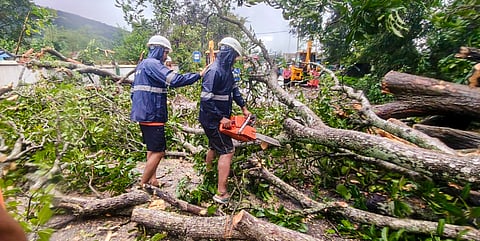

NEW DELHI: Climate change increased the damage caused by Cyclone Arnab, which struck eastern India on October 28, by 33 per cent, resulting in tens of millions of dollars in additional direct economic losses, according to a study by researchers at Imperial College London's Grantham Institute.
The study, published on Thursday, estimated that around 25 per cent of the cyclone's total economic damage was directly attributable to human-induced climate change, compared with a pre-industrial climate baseline.
Researchers found that climate change increased the cyclone's maximum wind speed by approximately 5 per cent and intensified its eyewall rainfall rate by 11 per cent at landfall.
Cyclone Arnab brought heavy rainfall and peak one-minute sustained winds of up to 202 kmph, causing severe damage to infrastructure across Andhra Pradesh.
For the analysis, researchers used the Imperial College Storm Model (IRIS) to simulate the cyclone under current climate conditions, with global temperatures approximately 1.3 degrees Celsius above pre-industrial levels, and compared the results with a hypothetical scenario without human-induced warming.
“These findings are a powerful reminder of the price of inaction. The costs of climate change are not hypothetical future projections — they are hitting coastal communities in eastern India today,” said Dr Nathan Sparks, a researcher at Imperial College London's Department of Physics.
