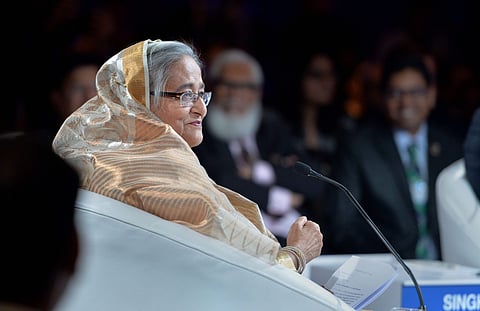

NEW DELHI: Bangladesh is facing a fresh spell of political uncertainty as former Prime Minister Sheikh Hasina’s announcement that she intends to return from exile in India has reignited tensions between her supporters and the authorities.
Violent street protests, a crackdown on demonstrators and an increasingly bleak economic outlook have placed the country in a difficult position, barely two years after a mass uprising ended Hasina’s 15-year rule.
The latest flashpoint came after Hasina sought a new passport and national identity card from Bangladesh’s diplomatic mission in New Delhi, signalling her intention to return in December and surrender before a court. The Bangladesh government, however, rejected the request and reiterated that it wanted her extradited from India under the bilateral treaty.
The announcement has galvanised supporters of Hasina’s Awami League, whose activities have been banned and which was barred from contesting the February 2026 general election.
Police have fired tear gas and rubber bullets to disperse pro-Hasina demonstrators, while clashes involving activists of the banned Bangladesh Chhatra League (BCL), the party’s student wing, have been reported in several areas.
The protests mark the first organised show of strength by Hasina's supporters since her government was toppled in August 2024. They also underline the difficulty of keeping the Awami League and its support base outside mainstream politics while addressing the grievances that contributed to the uprising.
“The return of Sheikh Hasina is not merely an individual political question; it has the potential to reopen the country's unresolved political conflict. That’s what makes Dhaka wary of this,” said a source.
The political stakes are particularly high because Hasina’s return would force the government to confront questions it has so far been able to defer -- whether the Awami League can be allowed back into political life, how its supporters should be treated and what happens to a former prime minister who has been sentenced to death in absentia.
The Bangladesh government has made its position clear. Home Minister Salahuddin Ahmed said the authorities were examining the legal basis and procedural validity of Hasinas passport application. He also reiterated that Dhaka had already sought her extradition from India.
“Let us be very clear on this: if Sheikh Hasina doesn't go back, the violence will continue and they will exterminate the Awami League,” said an Awami League candidate.
The Awami League has alleged that hundreds of its supporters have been killed in mob violence and that several others have died in the custody of security forces since Hasina’s ouster. The political confrontation is unfolding against an increasingly difficult economic backdrop.
The latest IMF World Economic Outlook, released in October, projects Bangladesh to become South Asia’s slowest-growing economy through 2031, raising concerns about the country’s ability to sustain employment, investment and household consumption.
The IMF has projected economic growth to slow to 3.2 per cent in FY27 and fall further to 2.2 per cent in FY28, before recovering only gradually to around 3 per cent by FY31.
Inflation is projected to average 10.9 per cent in FY27, its highest level in 16 years and substantially above the 6 per cent forecast made six months earlier.
Data compiled by human rights organisation Ain o Salish Kendra (ASK) recorded 401 incidents of political violence in 2025, resulting in 102 deaths and thousands of injuries.
Significantly, 192 clashes involved rival BNP factions, leaving 40 people dead. Another eight people died in internal clashes involving the party's youth wing, Jubo Dal. “For Bangladesh, the immediate challenge is to prevent Hasina's proposed return from becoming another trigger for widespread unrest.
The government must simultaneously address allegations of political persecution, restore confidence in democratic institutions and tackle an economy struggling with weak growth and persistent inflation,” said a source in the ruling BNP.
