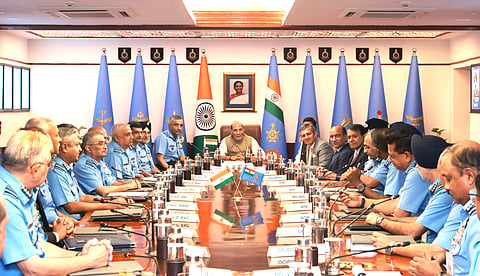

NEW DELHI: With its fighter strength at a six-decade low, the Indian Air Force (IAF) was told on Thursday that jet numbers alone will not win future wars. Victory, Defence Minister Rajnath Singh told the force's top brass, will also hinge on technological sophistication, speed of response and precision.
Addressing the Air Force Commanders' Conference here, Singh also asked the force to draw up dedicated doctrines and architectures for electronic, cyber and space warfare. According to the defence ministry statement, he wants these emerging domains made a "core priority" in planning and operations.
The conference, the first under new IAF chief Air Chief Marshal Ashutosh Dixit, comes amid a grim force-level picture. The IAF is down to just 29 fighter squadrons, as against the sanctioned 42.5. Worse, three MiG-29 and six Jaguar squadrons are slated for retirement by the end of the decade.
Replacements, in turn, are not coming in fast enough. State-run Hindustan Aeronautics Limited (HAL) is yet to deliver even one of the 180 Tejas Mk1A jets ordered while the mega project for 114 additional Rafales is yet to be inked.
All this comes when the IAF faces a collusive threat from China and Pakistan. China's PLAAF fields around 2,200 fighters, including over 300 fifth-generation J-20 stealth jets. Pakistan, for its part, is inducting Chinese J-10C fighters and eyeing J-35 stealth jets.
Citing the conflicts in Ukraine and West Asia, Singh asked commanders to gear up for kamikaze drones, surveillance and counter-drone operations. He also called for sharpening both the offensive and defensive dimensions of the "element of surprise".
"Our Defence Forces must develop capabilities and methods that leave the adversary with no time to react or recover, while simultaneously ensuring that we are never caught off guard," he said.
The lessons of Operation Sindoor in May last year, he added, were clearly reflected in the IAF's evolving operational procedures, with greater emphasis on drones and air defence. During those hostilities, IAF’s S-400 systems had shot down five Pakistani fighters and a surveillance aircraft, the latter at a distance of around 300 km.
Crucially, Singh said the armed forces were in a "transformative phase", with reforms in organisational structures, jointness and operational concepts that required "a forward-looking approach".
This is significant because the IAF has repeatedly cautioned against rushing into theatre commands and splitting its fighter squadrons among them. However, ACM Dixit, as Chief of Integrated Defence Staff (CISC) earlier this year, had described the move towards theatre commands as "a historic opportunity".
On the Agniveers, Singh said the Cabinet's November 4 decision to grant them a two-year "second tour of duty" was based on feedback from the armed forces. Under the tweak, the 75% of Agniveers earlier slated for release after their four-year stint will now have the option of serving two more years. The change, for now, applies only to Agniveers already in service or under training.
At the conference, the defence minister also launched a suite of AI applications developed in-house by the IAF's UDAAN unit to automate tasks in operations, administration and aerospace safety.
