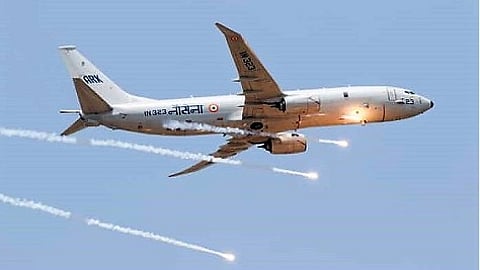

NEW DELHI: The Indian Navy on Wednesday marked 50 years of long-range maritime reconnaissance (LRMR). The capability began with five old Super Constellation aircraft grudgingly handed over by the Indian Air Force (IAF) in 1976 and has now graduated to a fleet of 12 Boeing P-8I aircraft that serve as potent submarine-hunters across the Indian Ocean Region (IOR).
The Super Connies, which had earlier flown as Air India airliners, were inducted into Indian Naval Air Squadron (INAS) 312 'Albatross', commissioned at INS Hansa in Goa on November 18, 1976. The squadron now operates P-8Is from INS Rajali at Arakkonam in Tamil Nadu, with another P-8I squadron, INAS 316, based in Goa.
The P-8Is, the military variant of the Boeing 737 airliner, drop sonobuoys into the sea to detect submarines. They are armed with torpedoes and Harpoon missiles to take on submarines and enemy warships.
Incidentally, unlike the US Navy's P-8A, the Indian version is also fitted with a magnetic anomaly detector in its tail. It can sniff out a submerged submarine from the faint disturbance its steel hull causes in the Earth's magnetic field.
The LRMR aircraft have been part of Op Cactus (Maldives, 1988), Op Vijay (Kargil, 1999), Op Parakram (2001-02) and Op Sindoor (2025), apart from anti-piracy patrols and search-and-rescue missions, the Navy said in its statement.
The New Indian Express looks at the hard-fought turf battle that gave the Navy this capability and at why these aircraft matter even more now, with Chinese submarines regularly prowling the Indian Ocean Region (IOR) and the government moving to buy six more P-8Is.
Hand-me-downs and a hard bargain
Maritime reconnaissance had been the IAF's preserve since Independence, in keeping with the British model. The IAF's No. 6 Squadron was re-raised at Pune in 1951 with B-24 Liberators for the role, and added Super Constellations retired by Air India in 1961.
The Navy formally sought control of all maritime patrol aircraft in 1966, contending that the IAF had not provided adequate cover at sea during the 1965 war with Pakistan. The IAF, in turn, argued that the system inherited from the RAF had served Britain and Australia well. The government let the IAF keep the role till new aircraft were inducted.
The 1971 war, however, exposed the glaring gap when, on December 9, Pakistani submarine PNS Hangor torpedoed the frigate INS Khukri off Diu, killing 18 officers and 176 sailors. The IAF's Super Connies could search for survivors, but not hunt the submarine.
The government then approved four new maritime patrol aircraft in May 1973, picking the Soviet-origin Ilyushin Il-38. In 1975, the defence ministry finally ruled that the Navy would operate them. The IAF handed over five Super Connies to the Navy, retaining two freighters for itself.
Naval crews, who had never flown four-engine aircraft till then, underwent a short course with No. 6 Squadron before moving to Goa. The Il-38s, the Navy's first long-range anti-submarine warfare (ASW) aircraft, were inducted into INAS 315 in October 1977.
The Super Connies flew till 1983, with India becoming the last military operator of the type. The Tupolev Tu-142M, inducted in 1988, extended the Navy's reach across the IOR. India then became the first international customer for the P-8 in 2009, with the first of the aircraft landing in 2013.
Why it matters more now
Five decades on, the P-8Is are the Navy's main weapon for tracking Chinese nuclear and diesel-electric submarines, which now make regular forays into the IOR. Chinese research and survey vessels, which map the seabed for submarine operations, are also kept under close watch.
Pakistan, too, has upped the ante, getting its first Chinese-designed Hangor-class submarine at Karachi in June and test-firing an anti-ship cruise missile from it in the North Arabian Sea three months later. Seven more are on the way. Their Stirling-engine air-independent propulsion (AIP) lets them stay submerged far longer than conventional boats, making them much harder to catch.
To keep pace, the Navy is adding to its fleet. In February, the defence ministry cleared the first step towards buying six more P-8Is. The 15 armed MQ-9B SeaGuardian drones ordered from the US, due in 2029, will add another layer of long-range surveillance.
China's growing undersea reach has also pushed maritime patrol aircraft up the Quad's agenda. On Tuesday, the Quad leaders met in Manila and announced that P-8 and P-3C patrol aircraft from India, the US, Japan and Australia will fly a joint maritime exercise for the first time in 2027. The exercise is part of a new Indo-Pacific Maritime Surveillance Collaboration, under which the four countries will share more information on movements at sea.
The four fly similar aircraft to the US and Australia's P-8A and Japan's own Kawasaki P-1 and older P-3Cs. Who flies them is another matter. In Britain and Australia, the two countries the IAF cited in 1966, it is the air force. In the US and Japan, as in India, it is the navy.
