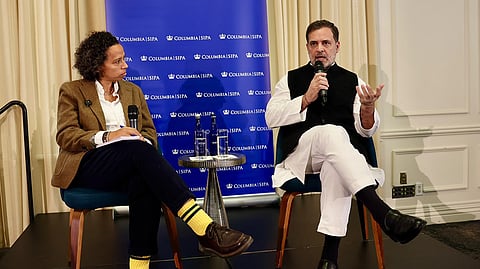

India is sitting on an “economic disaster” with massive unemployment, a broken manufacturing base and deep-rooted problems in its education system, Leader of Opposition in the Lok Sabha Rahul Gandhi said, warning that the country risks getting into serious trouble if it continues on the current economic path.
Speaking at a fireside chat at Columbia University in New York on Tuesday, the Congress leader said India's economic model "stopped giving results almost a decade ago" and criticised the government's initiatives such as 'Make in India' and 'Start-up India', claiming they had failed to revive the country's "broken" economic backbone.
"The blunt thing is that India is sitting on an economic disaster. That's the reality of it. One can brush it aside, the media can brush it aside. But India has got a massive unemployment problem. India's got a massive problem with its education system," he said.
Gandhi, who arrived in New York on Tuesday morning, was addressing hundreds of students and faculty members at the university.
Arguing that small and medium businesses and agriculture form the backbone of India's economy and are crucial for job creation, he said the country's manufacturing sector needed to be rebuilt.
"The spine of the economy is small and medium business, which is the job creation engine, and agriculture. That is fundamental in India and required," he said, adding that the "spine of the economy has been broken".
"You cannot give enough people jobs through services. It cannot be done. You can give 1%, 2%, 3%, 5%. You cannot give everybody a future with services. And we've just basically decided that we don't need manufacturing,” Gandhi said.
He questioned the lack of private investment and alleged that only a handful of large business groups, including those of Gautam Adani and Mukesh Ambani, were expanding, while smaller businesses were struggling.
“Why is there no private investment in India? Why are the only people who are growing in India, businesses that are growing in India called Adani and Ambani? Why is Tata literally being taken over by Mr Adani?”
Gandhi alleged that the economic architecture painstakingly built by the Congress party had been weakened and called for rebuilding it, saying India could not successfully develop without a strong manufacturing base.
"We cannot survive successfully without manufacturing, it just cannot be done," he said.
Referring to the student protests that erupted in some parts of the country, including in Delhi, this summer, Gandhi said the demonstrations were not sudden but part of a broader pattern of resistance against the concentration of political and economic power over nearly a decade.
"As power has been concentrating in India, different groups have been resisting at different levels in different places, and that has been going on for almost a decade now,” Gandhi said.
He cited protests by adivasis, dalits and farmers, alleging that different sections of society had been affected by the concentration of wealth and power.
"There's a massive concentration of wealth taking place in India, and huge disenfranchisement of people," the Opposition leader said, citing what he described as the "snatching" of tribal land without consultation, attacks on minorities, dalits and farmers, and concerns over the electoral process.
Gandhi said the concentration of wealth and power is now being recognised across sections of society, including the business community, with business people increasingly approaching him with concerns about the direction of the economy.
He also alleged that electoral irregularities has undermined the democratic process in India and said removing Chief Election Commissioner Gyanesh Kumar was among the steps needed to restore it.
"From the day your elections are rigged, the politics has stopped. There is no politics taking place. It looks like it's taking place, but it's actually not taking place," he said.
Gandhi said the "idea is to restore the electoral system" as “without that, nothing is going to happen”.
The Congress leader said his party was working towards this goal and had gathered substantial evidence of electoral malpractice.
He claimed that several people within the system, who had earlier been afraid to speak out, were now coming forward and sharing information with the Congress.
“I see it with quite a positive light,” Gandhi said, but cautioned that the government could respond aggressively as pressure mounted.
“If the pressure goes beyond a certain point... the government will react nastily ... probably react violently and aggressively,” he said.
On the impact of tightening US immigration policies on Indian students aspiring to study and work abroad, Gandhi said the issue was relatively small compared to India's larger employment and economic challenges.
"This is a very small percentage of the larger problem. It’s not that 30% of India is going out and getting themselves a job. One mustn't get clouded about that," he said.
While acknowledging that many Indian students had benefited from opportunities abroad, Gandhi said the focus should remain on addressing the country's domestic challenges.
"India's problem is much more basic. How do you make agriculture successful? How do you actually start production in India? How do you build a manufacturing sector? How do you build an education system that is efficient, effective, and not unaffordable? These are much bigger, broader questions," he said.
Commenting on the recent US midterm elections, Gandhi attributed the Republican Party's electoral setback to rising fuel prices and said it reflected a rapid decline in American power, arguing that Washington had been unable to impose its will on Iran.
"Why did fuel prices in the United States shoot up? Because American power could not keep them down. America could not impose its will on an Iran. So what we are seeing is the rapid reduction of American power,” he said.
On rising youth unemployment in the US and Europe, Gandhi said countries such as the US, Germany and Britain were facing more serious economic difficulties than India, citing the country's lower costs and ability to withstand economic hardships.
"I am very optimistic about India. I worry that we are wasting time. I worry that another 10 years of this, five years of this, we’ll really be in trouble. That's what I think,” he said.
(With inputs from PTI)
