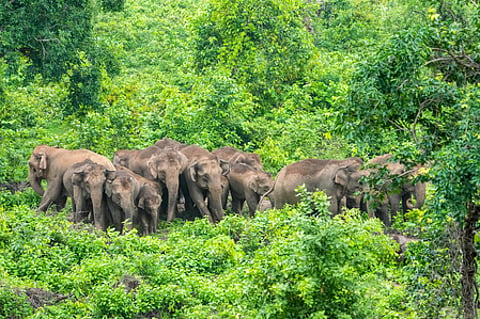

RANCHI: To curb the growing human-elephant conflict, the Jharkhand Forest Department has stepped up efforts to strengthen 75 traditional elephant migration routes, known as elephant corridors, by ensuring adequate food and water along them.
The initiative aims to provide elephants with safe passage through forests and prevent them from entering villages in search of food and water, officials said.
Principal Chief Conservator of Forests (PCCF) Sanjeev Kumar has directed officials to develop grazing grounds, improve water availability and create awareness among local communities in areas frequented by elephants.
“We have identified 75 elephant corridors across the state and decided to ensure adequate availability of food and water along these routes so that elephants do not stray into villages in search of sustenance. This will help minimise human-elephant conflict,” said PCCF Sanjeev Kumar.
The corridors have been classified as highly, moderately and less sensitive, he said, adding that development work would be prioritised based on these categories.
“We will prioritise the highly sensitive elephant corridors, followed by those classified as medium and low sensitivity, for development,” the PCCF said.
The sensitive corridors will also be equipped with an Artificial Intelligence (AI)-based Elephant Alert System to detect elephants entering an area and alert nearby villages through hooters, he added.
Highly sensitive corridors have been identified in areas including Ramgarh, Hazaribagh, Chatra, Palamu, Jamshedpur and Chaibasa.
Kumar also said the country's first human-elephant conflict research centre was being established in the Palamu Tiger Reserve (PTR), for which a 15-acre site had been identified.
The proposed centre will analyse data on human-elephant conflicts and prepare reports suggesting ways to reduce such incidents. It will also use AI technology for research and assessment.
Wildlife experts said the expansion of human activity along traditional elephant migration routes had forced the animals to move towards human settlements. They warned that the conflict could become more dangerous if the corridors were not restored.
Elephants move from one area to another in search of food, and attacks often occur in places where grain is stored inside houses. Forest clearance and encroachment on natural migration routes have further worsened the situation.
Human-elephant conflict has emerged as a major challenge in Jharkhand. Between 2008 and 2024, elephant attacks claimed 1,251 human lives, while 202 elephant deaths were also recorded.
Government data show that elephants are present in 20 of the state's 24 districts, causing an average of 80 human deaths and 150 injuries every year. The Jharkhand government provides Rs 4 lakh in compensation to the families of those killed in elephant attacks.
