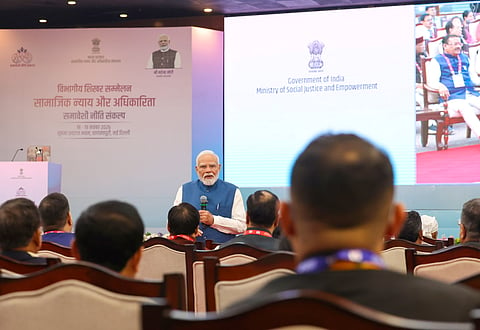

Prime Minister Narendra Modi on Thursday called for greater involvement of communities, spiritual organisations and educational institutions in the fight against substance abuse, saying efforts to build a drug-free India must go beyond routine and symbolic activities.
Chairing the valedictory session of the Departmental Summit on Social Justice and Empowerment, Modi also stressed the need for greater public participation in identifying disabilities early and tackling the social stigma that often prevents parents from seeking timely support for their children.
In a post on X, the Prime Minister said the summit had focused on greater public participation in social welfare schemes, encouraging startups to develop affordable assistive technologies and adopting a whole-of-society approach to the Nasha Mukt Bharat Abhiyan.
The summit brought together ministers and senior officials from states and Union Territories to discuss social inclusion, the empowerment of people with disabilities, prevention of substance abuse and ways to expand public participation.
Modi said the discussions and action points reflected a shared sense of purpose between the Centre and states. He called for competitive and cooperative federalism to guide implementation, with states learning from one another's experiences and innovations.
On disability-related issues, the Prime Minister said hesitation, fear of social stigma and lack of awareness often prevent parents from recognising disabilities or seeking support for their children at an early stage. He said a community-based approach could help overcome such reluctance and make early intervention more acceptable.
He also called for innovative awareness campaigns using technology to communicate important messages in simple and accessible ways.
Modi suggested that states organise startup competitions to encourage young innovators to develop affordable assistive devices, particularly those that improve mobility, accessibility and participation in sports and everyday activities.
Turning to the Nasha Mukt Bharat Abhiyan, he said efforts to tackle substance abuse should not be confined to routine programmes or symbolic activities. He proposed involving schools through essay-writing, debates, oratory competitions and other activities to raise awareness among young people.
The Prime Minister also highlighted the importance of sharing the experiences of people who had successfully overcome addiction, saying such accounts could encourage others to seek help.
Calling for a whole-of-nation approach, Modi urged communities, spiritual organisations, educational institutions and government ministries to participate more actively in the campaign.
He said lasting behavioural change would require society itself to become an active participant in the effort to make India drug-free.
Modi reiterated that the Centre and states were partners in a common national endeavour and said the collective commitment demonstrated at the summit should be carried forward to build an inclusive and empowered Viksit Bharat.
(With inputs from PTI)
