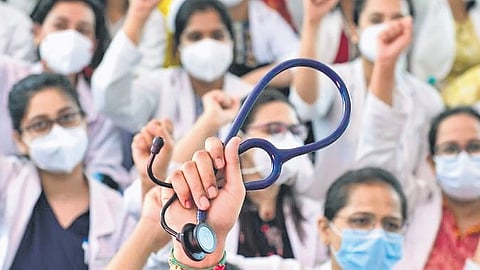

NEW DELHI: Foreign Medical Graduates (FMGs) have some good news to cheer about. The centre has agreed to two of the long-standing demands of the FMGs, who have been protesting over these issues for the past several months.
While the Directorate General of Health Services (DGHS), under the Union Health Ministry, has approved stipend parity for FMG interns at par with the Indian Medical Graduates (IMGs) in five central hospitals, including Safdarjung and RML Hospital, the National Medical Commission (NMC), a statutory body regulating medical education and medical professionals in India, has proposed a draft regulation which seeks to simplify eligibility requirements for FMGs.
In a notice dated November 16, Prof. (Dr.) B Srinivas, Deputy Director General, Directorate General of Health Services (DGHS), said that all “FMG interns shall be paid a stipend as fixed by the appropriate authority.”
“..the Competent Authority has accorded approval for disbursement of stipend to Foreign Medical Graduate (FMG) interns at par with that paid to Indian Medical Graduates (IMGs),” said the notice, marked to Medical Superintendents of Vardhman Mahavir Medical College (VMMC) and Safdarjung Hospital and Atal Bihari Vajpayee Institute of Medical Sciences and Dr. Ram Manohar Lohia Hospital; and to the Directors of Lady Hardinge Medical College and Associated Hospitals; NEIGRIHMS (The North Eastern Indira Gandhi Regional Institute of Health and Medical Sciences), Shillong and the Regional Institute of Medical Sciences, Imphal.
Senior Union Health Ministry officials told this paper that the order applies only to these five central government-administered medical colleges. They hoped that other states could also follow the order as an advisory.
In a draft regulation dated November 17, the NMC proposes amending rules governing FMGs, seeking to remove the requirement that their licence to practise medicine in the country where they obtained their medical degree must match the licence granted to citizens of that country.
Under the new rule, an FMG would need to be registered with the relevant professional regulatory body in the country where they earned their medical degree.
The existing provision requires the graduate to be registered with the respective professional regulatory body or otherwise be competent to obtain a licence to practise medicine in that country’s jurisdiction, with the licence being equivalent to that granted to citizens of the country.
The proposed amendment substitutes this provision with the requirement that the graduate be “registered with the respective professional regulatory body in that country.”
The NMC has invited objections and suggestions from stakeholders.
Speaking with this paper, Dr Samar Kumar, National President, All FMGs Association (AFA), an advocacy group representing graduates who completed their MBBS outside India, said they welcome the two decisions, which have long been their demands.
“We thank DGHS for this positive decision and urge the authorities to ensure nationwide implementation without further delay,” he said, adding that their demand is equal stipend, timely payments and pending arrears for all eligible FMG interns.
According to Dr Zoya Maryam, National FMG In-Charge, Federation of All India Medical Association (FAIMA), a national body of resident doctors and medical students in India, foreign medical graduates working as interns in hospitals in India were not being paid stipends.
“There have been widespread protests on this issue. Indian medical graduates are paid anywhere between Rs. 20,000-Rs. 30,000, depending on the hospital and state. But FMGs, doing the same work, are either not paid or given unequal stipends. Our demand has always been stipend parity,” she told this paper.
On the draft regulation, Dr Kumar said they welcome the NMC for agreeing to amend the Foreign Medical Graduate Licentiate Regulations, 2021 (FMGL Regulations, 2021), which set the eligibility and licensing rules for FMGs seeking to practice modern medicine in India.
“This has been our long-standing demand. We hope this amendment will benefit a large number of Indian students studying abroad,” he added.
However, he said, they want the NMC to address four key issues: a one-time exemption for the 2021-22 batch; one-time university transfer; internship flexibility; and clarity on foreign registration.
“NMC must clearly define whether registration means obtaining a licence to practise, passing the country’s licensing examination, or simply registering with its medical regulatory body, considering that every country has different rules,” he told this paper.
“We hope these genuine concerns are addressed before the final amendment,” Dr Kumar said
