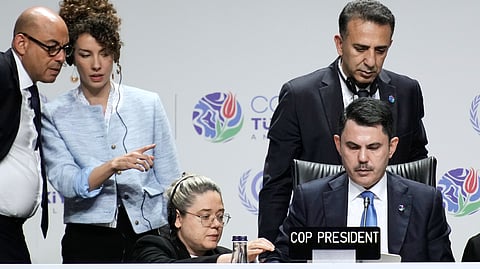

NEW DELHI: The UN climate summit in Antalya, Turkiye, closed without a deal on phasing out fossil fuels or on funding for poorer countries, after more than two weeks of talks that ran well past their deadline.
Since no consensus was reached in the talks called COP 31, the draft Antalya pact has no formal standing. Countries agreed to continue discussions, reports, and prepare a roadmap for COP32 in Addis Ababa in 2027.
Organised under twin presidencies of Turkiye and Australia, both fossil fuel producing nations, a major failure of COP31 was political responsibility. Developed nations, including the EU, the UK, and Japan, resisted making measurable commitments to fund climate action. Conversely, major fossil fuel-producing countries such as Saudi Arabia and Russia opposed stronger language on transition away from oil, gas, and coal.
As a result, the draft text included provisions for an electrification goal and carbon capture but did not feature strong commitments against fossil fuels or public financing required by developing nations. Its main aspiration was large-scale deployment of carbon capture by 2035, with no emission-cut commitments.
That is a step back from COP28, three years ago in Dubai, when countries agreed to transition away from fossil fuels. The financing provisions showed a deep divide, too. Although the text reinstated an explicit reference to the Paris Agreement — which obliges developed countries to provide financial resources — there were no new commitments attached.
The call to triple adaptation finance by 2035 remained, but without an agreed baseline or delivery pathway, and the proposed $120 billion adaptation finance figure was excluded.
There was one compromise: the IPCC’s role in the 2028 Global Stocktake, which eased concerns raised by India about a rushed assessment cycle.
India shapes draft outcome
Union minister Bhupendra Yadav said India’s voice shaped the draft COP31: food security, livelihoods recognised in action on methane; Article 9.1 obligations of developed nations recalled; equity, CBDR-RC at the heart of implementation.
