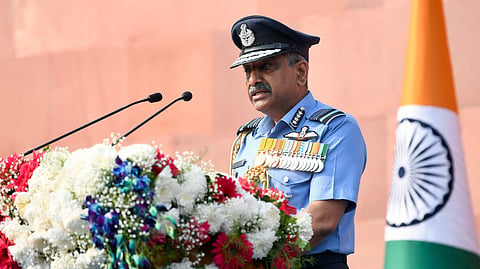

India had limited options to impose a cost on those who orchestrated the 26/11 Mumbai terror attacks, but the situation has changed "drastically", with the country responding forcefully after the attacks in Uri, Pulwama and Pahalgam, Air Chief Marshal Ashutosh Dixit said on Thursday.
Speaking at an event in Mumbai, Dixit said the 26/11 attacks had also tested the state as a whole, exposing gaps in intelligence sharing, coastal surveillance, response times and coordination among various agencies.
"In 2008, the state had limited options to impose a cost on those who planned and sponsored the attacks. That position has since changed drastically," Dixit said.
He said India responded firmly by reforming its security apparatus, pointing out that the National Investigation Agency (NIA) was established in December 2008, National Security Guard (NSG) hubs were set up in Mumbai and other cities, and coastal security was revamped under the overall responsibility of the Indian Navy.
These reforms have served the country very well, Dixit said.
The 26/11 attacks showed that no single agency could safeguard national security, he said, adding that Operation Sindoor demonstrated what was possible when political leadership, diplomacy, intelligence and the armed forces acted together. The result was "stupendous", he said.
In 2016, following the Uri attack, the Army struck terrorist launch pads across the Line of Control. In 2019, after the Pulwama terror attack, the Indian Air Force struck a terrorist training facility at Balakot, deep inside Pakistan. Operation Sindoor followed after terrorists killed 26 people in Pahalgam in April 2025, Dixit said.
Precision strikes during Operation Sindoor destroyed terrorist infrastructure at nine locations in Pakistan and Pakistan-occupied Kashmir, he said.
"When Pakistan escalated with drones and missiles against our cities and military installations, our air defence held. Our strikes then hit radars, command and control centres, runways, and hangars across 11 air bases. Within four days, the adversary sought a cessation of military action," Dixit said.
Air power offers "reach without occupation", he said, adding that it also provides precision, allowing force to be applied in proportion to the objective.
It also offers speed, ensuring that a response follows a provocation closely enough to be understood as one, the Air Chief said. Air power also provides control, allowing the intensity of action to be increased or reduced depending on the situation.
An air strike is "one half", while the other half is air defence, as punishment deters only when a nation can withstand an adversary's counter-strike, Dixit said.
"During Operation Sindoor, our integrated air defence denied the adversary that leverage. The ability to strike and the ability to protect must be built together," he said.
Operation Sindoor also highlighted areas that required improvement, Dixit said.
"First (issue) is the time from intelligence to action - it has to shrink still further. So, we have sensors, we have to analyse them, and the shooters across the services and national agencies must work from one consolidated picture in near real-time," he said.
Escalation must be managed as deliberately as it is initiated, Dixit said, adding that every step needed a "clear aim, a measured scale, and a planned exit".
Signalling to the adversary and the international community was also part of the operation itself, he said.
"Homeland is now part of the battle space", the Air Chief said, pointing out that Pakistan's drones and missiles were directed at Indian cities during Operation Sindoor.
"The contest of narratives begins within hours. False claims of losses were circulated by adversary at scale during the operation. Facts released with speed and credibility are now an operational requirement," Dixit said.
Referring to the ongoing West Asia crisis and the Russia-Ukraine war, he said the conflicts showed that wars were likely to last longer than their planners intended.
Over time, the side capable of sustaining military production and replacing its losses would have the advantage, he said.
An adversary could also strike in cyberspace without crossing the border, Dixit said, while flagging the potential threat posed by quantum technologies, which could eventually "break the encryption on which many of our systems depend today."
Preparation for quantum-safe processes must begin well before that day arrives, he said.
(With inputs from PTI)
