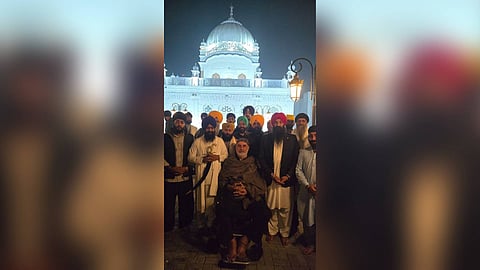

CHANDIGARH: The historic Gurdwara Patshahi Chhevin Khara Sahib (Bhai Ke Mattu), in the Naushehra Virkan area of Gujranwala district of Punjab province in Pakistan, has been restored and reopened for devotees after remaining closed for nearly 80 years following the partition in 1947.
The Akal Takht (Highest temporal seat of Sikhs) Jathedar conducted the formal reopening of a gurdwara after restoration. The reopening marked the restoration of Sikh religious activity at the shrine, which had remained neglected for decades.
The ceremony was led by Akal Takht Jathedar Giani Kuldeep Singh Gargaj and Pakistan Sikh Gurdwara Parbandhak Committee president and Punjab Minister for Minorities Ramesh Singh Arora.
The restoration was completed in time for the 557th birth anniversary of Guru Nanak Dev, marking a significant step towards preserving the centuries-old religious structure.
According to historical accounts, Guru Hargobind Sahib visited the site in 1620 while returning from a journey to Kashmir and stayed there for about a month, preaching Sikh teachings.
The restoration work was undertaken by the Seva Sambhal organisation, led by Barjinder Singh Hussainpur, son of SGPC member Mohinder Singh Hussainpur, and Sukh Sagar Kaur, along with their family members.
The initiative was completed with the efforts of the Sikh sangat, the Evacuee Trust Property Board and the Punjab Government of Pakistan. The National College of Arts, Lahore, provided technical advice for the restoration.
Husainpur said that the shrine's historic architectural features, including old stones and traditional ornamentation, were retained during the restoration. The old samadhi of Bhai Jaspat was also restored.
Addressing the gathering, Akal Takhat Jathedar Giani Kuldeep Singh Gargaj appreciated the restoration team for retaining the original architectural character and said that heritage preservation should be prioritised over demolishing old structures and rebuilding them.
He added that the Sikhs had been separated from numerous historic gurdwaras during partition and efforts were needed to preserve and restore the shrines in Pakistan.
Accompanied by the Panj Pyare, Gargaj also offered prayers before the reopening, seeking restoration of other historic Sikh shrines separated from the community during Partition.
He urged Ramesh Singh Arora and local National Assembly member Azhar Qayyum Nahra to ensure that Sikh pilgrims visiting Pakistan were also taken to Gurdwara Khara Sahib.
Speaking on the occasion, Arora said the Punjab government was taking practical measures to preserve religious heritage, restore historic places of worship and ensure that minority communities could freely practise their faith.
He said the restoration reflected Chief Minister Maryam Nawaz's commitment to protecting historic religious sites and promoting the welfare and rights of minority communities.
"The Gurdwara Sri Khara Sahib has been restored while preserving its original architectural character, historical significance and religious identity. Our objective is to ensure that members of the Sikh community can visit this sacred place and offer their prayers in accordance with their religious traditions," he said.
The existing masonry structure of the gurdwara was built around 1940. Mai Seho, a resident, constructed the sarovar. The shrine remained under the management of the Shiromani Gurdwara Parbandhak Committee, and Guru Granth Sahib was continuously installed between 1900 and 1947.
A local pandit became a Sikh during the Guru's stay and was bestowed the title of Bhai. The Guru's wedding procession is also believed to have passed through the area towards Mariyali village, giving the shrine its historical association.
An annual fair was held on the fifth, sixth and seventh days of the month of Sawan. Historical accounts credit Bhai Jaspat with arranging food supplies from villages and preparing langar for Sikh warriors during difficult times.
Notably, he also oversaw the construction of the Manji Sahib and the dome at the gurdwara.
