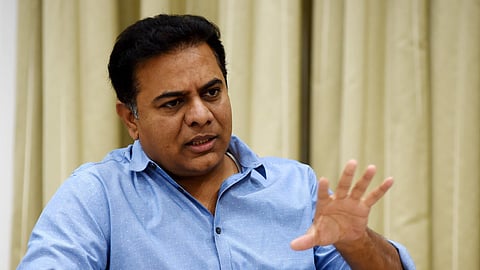

BRS Working President K T Rama Rao on Sunday challenged the Congress to spell out its alternative to population-based delimitation, saying the party should propose a different formula if it believes that increasing parliamentary representation proportionately across states is not the right approach.
Speaking to PTI, Rama Rao said the BRS's decision to support the Centre's proposed delimitation exercise was a victory for southern states, as the revised proposal would increase Lok Sabha seats by 50% across the board while retaining the South's share of representation at 24%.
Calling it a departure from the population-based formula proposed earlier by the NDA government, he said parties such as the BRS had forced the Centre to drop that approach.
"Eventually, it is a huge victory for parties like us and the South of India, who have forced the Government of India to remove population as the basis and create a proportionate increase in seats," he told PTI Videos.
Rama Rao said the Congress should clarify whether it favoured population as the basis for delimitation or had another formula in mind. Suggesting gross domestic product (GDP) as one possible alternative, he said southern states account for 34-35% of India's GDP and challenged the Congress to support a corresponding share of Lok Sabha seats for the region.
"If GDP is the method... South India contributes 34-35 per cent to India's GDP today. If Congress promises 34-35 per cent of seats in the Lok Sabha, then we will welcome that," he said.
He warned that using population as the basis would penalise southern states for having effectively controlled population growth and would amount to a betrayal of the region.
He also called for safeguards against gerrymandering and demanded that the delimitation exercise be conducted transparently, with representatives of all political parties included in the Delimitation Commission. He said the Centre should address concerns over the process and ensure that it was carried out methodically and judiciously.
Rejecting the Congress's allegation that the BRS had changed its position on delimitation, Rama Rao said his party had consistently opposed population-based allocation of seats, not the constitutional exercise itself. Citing Article 82 of the Constitution, he said delimitation was a constitutional mandate and could not be left to the discretion of political parties.
He also questioned the Congress's criticism of the exercise, asking whether the party had indulged in gerrymandering during the delimitation exercises conducted in 1951, 1961 and 1971, when it was in power at the Centre.
On Congress leaders meeting DMK president M K Stalin to persuade him to reconsider his party's support for the proposed legislation, Rama Rao questioned the Congress's political approach, saying it had itself "dumped" Stalin a few months ago.
He asked the Congress to clarify whether it wanted delimitation to be deferred altogether or the existing strength of 543 Lok Sabha seats to remain unchanged.
The Centre is set to introduce a fresh constitutional amendment bill in the Lok Sabha on Monday to facilitate the implementation of one-third reservation for women by increasing the representation of every state and Union Territory by 50%.
The Constitution (132nd Amendment) Bill, 2026, proposes raising the maximum strength of the Lok Sabha to 850, comprising up to 815 members from states and 35 from Union Territories. It also seeks to increase the maximum permissible strength of state legislative assemblies from 500 to 650.
The revised seat allocations and constituency boundaries are proposed to remain frozen until 2051. Parliament has convened a special sitting, with the Lok Sabha scheduled to meet from November 30 and the Rajya Sabha from December 2. The sittings are scheduled to conclude on December 3.
(With PTI inputs)
