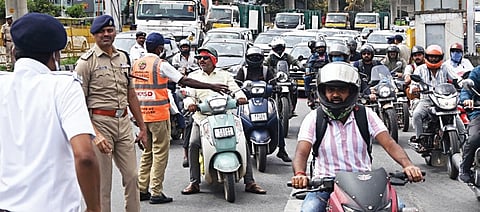

NEW DELHI: Two-wheelers carry 42.6% of Indian workers to fixed workplaces, making personal motorbikes and scooters the nation’s preferred choice for daily employment travel. Survey data reveals that 83.4% of workers reach their workplaces in under 30 minutes, keeping average travel times relatively brief across the country. Only 15% of workers use public transport options like buses, trains, etc.
The National Sample Survey Office published these benchmark figures following an extensive study covering 4,92,023 households and 20,34,371 individuals across 14,274 villages and 10,377 urban blocks. The government recorded trips longer than 1 km to track long-term transit requirements.
For a Delhi commuter spending over Rs 1,000 every month on basic transit, local travel costs form a sizeable share of monthly living expenses. Indian workers spend an average of Rs 785 per month on their daily workplace commute. Urban employees pay Rs 1,044 every month, while rural workers spend Rs 612.
Male workers spend Rs 835 per month, compared with `533 spent by female workers. Furthermore, 61.9% of male workers make daily work trips exceeding 1 km, whereas only 41.9% of female workers undertake similar commutes.

Students display distinct travel habits. About 66.4% of students aged six and above travel more than 1 km to reach their schools or colleges. Walking leads student travel at 37.0%, while buses carry 29.5% and bicycles 15.8% of young learners. Auto-rickshaws carry 10.5% of students nationally.
Average student travel takes 23 minutes, with 87.6% arriving in half an hour. Monthly student travel expenses average Rs 443 nationwide. Urban students pay Rs 617 per month, and rural families Rs 361. Peak student departures occur between 8:00 am and 9:00 am.
Long-distance household travel patterns show reliance on road network infra. Buses carry 55.8% of overnight trips, while inter-city railways carry 17.7% of travellers. Private cars account for 15.1% of journeys, and two-wheelers handle 8.8%. Social, communication and religious activities drive 70.2% of overnight trips.