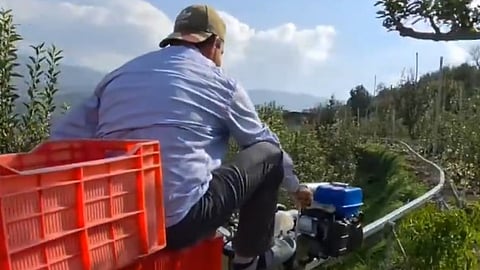

CHANDIGARH: Apple growers in Himachal Pradesh are testing Chinese-made monorail systems to transport harvested apples from orchards to warehouses to tackle labour shortages and rising wages in the hill state.
The petrol-powered systems run on tracks laid along slopes in orchards and can operate on gradients of up to 45 degrees. Trials are underway at individual orchards in Kotkhai, Shimla district, and under the Himachal Pradesh Sub-Tropical Horticulture, Irrigation and Value Addition (HPSHIVA) Project, which receives financial support from the Asian Development Bank (ADB).
The initial phase includes a 300-metre track that has been completed and successfully tested, with plans to extend it to one kilometre. A team from the Indian Institute of Technology Mandi (IIT Mandi) prepared a technical feasibility report to assess the system's potential to transport fruit and agricultural inputs across hilly terrain.
The Horticulture Department's Sundernagar team inspected the project on October 3.
“The project covers approximately 21.5 hectares and has generated enthusiasm among local horticulturists. Based on the trial results, expansion to other clusters may be considered,” an official said.
Harish Chauhan, president of the Fruit Vegetable Flower Growers Association, said labour shortages had prompted some orchard owners in Kotkhai and the HPSHIVA Project in Mandi to test the systems.
“Two monorail systems are being tested under the HPSHIVA Project in Mandi, while a few apple growers have purchased their own systems and are conducting trials in their orchards in Kotkhai. If the trials are successful, more apple growers and horticulturists in the state may adopt the technology,” Chauhan told TNIE.
The systems cost between Rs 4 lakh and Rs 12 lakh, depending on the track length, he said.
Currently, labourers and mules transport apples from orchards to warehouses. During the apple season, an orchard may employ between five and 20 labourers. Transporting 1,000 apple boxes can cost between Rs 30,000 and Rs 60,000, depending on the distance and terrain, Chauhan said.
He estimated that adopting monorail systems could reduce recurring transportation costs by 70-80 per cent after the initial investment.
Himachal Pradesh's steep terrain and small landholdings have long posed challenges to mechanisation. However, Chauhan said the systems could benefit multiple growers because orchards, vegetable fields and other horticultural plots are often located on stepped terrain rather than in consolidated blocks.
“Groups of 15 to 20 farmers could jointly purchase and install a system, although individual growers could also invest in one. This could save between Rs 10,000 and Rs 50,000 during the apple season,” he said.
Chauhan said the association would urge the state government to provide a 90 per cent subsidy for the systems to make them affordable for farmers.
Sunil Chauhan, an apple grower in Kotkhai, has imported a monorail system from China for around Rs 4 lakh and is testing it in his orchard. The system is operating smoothly and can carry up to 500 kg, transporting apple boxes, crates, manure, fertilisers, tools and other agricultural supplies, he said.
He has laid 100 metres of track and plans to extend it by another 200 metres at different locations and in different directions within the orchard.
“It will reduce my dependence on labour to a large extent,” he said.
Sunil Chauhan said mechanisation was becoming increasingly important as orchard management remained heavily dependent on manual labour, including workers from Nepal. Growing labour shortages and rising wages have added to growers' challenges, he said.
Chauhan added that apple-growing countries such as Italy had highly mechanised orchards, which were generally larger than those in Himachal Pradesh.
Monorail systems have also received substantial investment and development in steep fruit-growing regions of China, including Huaping County in Yunnan province and Gulin County in Sichuan province.
