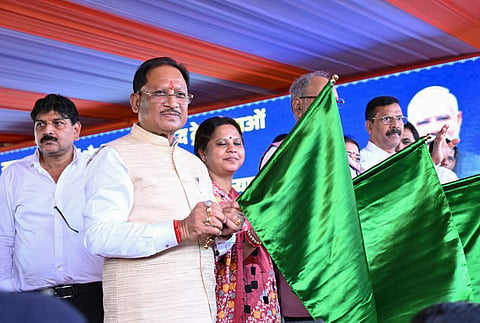

RAIPUR: Union Railway Minister Ashwini Vaishnaw and Chhattisgarh Chief Minister Vishnu Deo Sai on Tuesday jointly flagged off new passenger train services connecting the state capital Raipur to Rowghat and Raipur to Kurud, unlocking direct rail connectivity to the fringes of Abujhmad for the first time since Independence.
The occasion also saw the dedicated commissioning of the newly completed Tadoki–Rowghat rail section alongside the Abhanpur–Kurud broad-gauge line. In addition, the dignitaries laid the foundation stone for a state-of-the-art Electric Locomotive Maintenance Facility in state capital, Raipur to service high-power electric engines and bolster regional railway logistics.
Overcoming geographical and security odds, this corridor to Bastar’s Rowghat does far more than integrate an isolated frontier into the national railway grid, it promises to serve as a transformative socio-economic catalyst, laying the tracks for accelerated industrial growth, vital market access, and widespread regional empowerment.
Union Minister Ashwini Vaishnaw informed that large-scale railway development initiatives are currently underway across Chhattisgarh under the visionary leadership of Prime Minister Narendra Modi. “Railway infrastructure projects worth approximately Rs 54,000 crore are actively being executed across the state to modernise and expand regional rail connectivity”, he added.
“Beyond easing daily mobility for local communities, the expanded rail network is set to serve as an enduring socio-economic catalyst—galvanizing regional commerce, local industry, educational access, healthcare delivery, and employment opportunities across the state”, CM Sai said.
The rail connectivity is also deemed vital for the SAIL’s flagship company Bhilai Steel Plant in Durg district. As existing iron ore deposits in Dalli Rajhara face depletion, the high-grade iron ore reserves of Rowghat will now directly feed and sustain major industrial hubs.
Connecting this interior pocket to the Indian Railways grid has been a century-long journey. The British conducted the first survey in the region in 1914, followed by forestry tramways operating between Kurud and Likma during 1917–1918. However, completing modern broad-gauge tracks took over a hundred years due to difficult hilly terrain, complex revenue surveys, and decades of intense Naxal insurgency.
Constructing the 95 km Dalli Rajhara–Rowghat rail corridor involved severe security challenges: The track was constructed in six phased stages: Dalli Rajhara–Gudum (17 km, 2015), Gudum–Bhanupratappur (17 km, 2018), Bhanupratappur–Kewti (8 km, 2019), Kewti–Antagarh (18 km, 2020), Antagarh–Tadoki (17 km, 2023), and finally Tadoki–Rowghat (18 km, 2026).
